Digital Sales Room
PRO TIPS

By
Dhruv
How to Win Enterprise SaaS Deals: Proven Strategies to Close High-Value Accounts
The playbook has changed. Enterprise buyers in 2026 are sharper, more risk-averse, and allergic to vendor pitches.
They arrive at your first meeting having already shortlisted three competitors, consumed your G2 reviews, and benchmarked your pricing through channel partners.
The old approach, product pitch, feature dump, discount collapses under that kind of scrutiny.
What closes six- and seven-figure software deals today is something else entirely: genuine business partnership, outcome-led conversations, and a process disciplined enough to survive a twelve-month sales cycle without losing momentum. Here's how to build that.
Schedule a Strategy Call: Map your path to closing six- and seven-figure deals with a proven framework.
What Enterprise SaaS Sales Actually Means in 2026
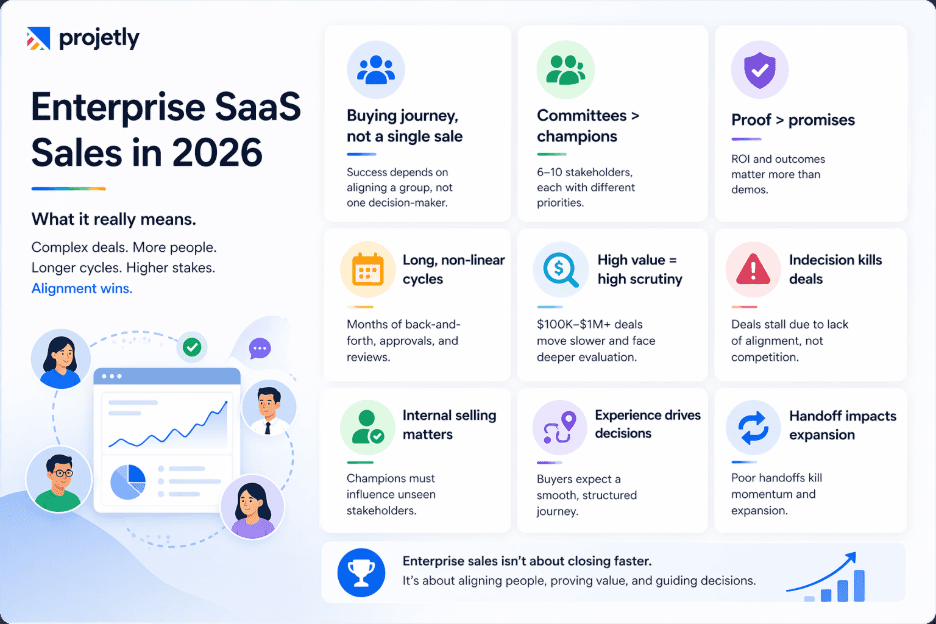
Enterprise SaaS sales are high-stakes, multi-threaded selling. You’re not closing a deal with one buyer; you’re aligning an entire organization around a decision that’s expensive, risky, and highly scrutinized.
Typical deals involve 6–10 stakeholders, six-figure (or higher) contracts, and sales cycles that stretch for months. Each stakeholder evaluates your solution through a different lens: finance cares about ROI, IT risk, and leadership about outcomes. If alignment breaks, deals don’t get lost; they stall.
That’s the reality: enterprise sales aren’t about persuasion. It’s about coordination, clarity, and momentum across a complex buying group.
According to Harvard Business Review, 87% of B2B sales opportunities face moderate-to-high buyers in decision, and that indecision is directly correlated with lost deals. The average enterprise software purchase involves 6 to 10 decision-makers.
And HubSpot's data shows that deals with an annual contract value above $100,000 carry an average sales cycle of 170 days, nearly six months for a straightforward deal, and considerably longer when multiple business units or regulated industries are involved.
Understanding those numbers isn't just context. It's a blueprint for how to allocate time, energy, and resources across a pursuit.
Not a single sale, but a coordinated buying journey: Enterprise deals require alignment across an entire buying group, not just one decision-maker
Committees, not champions, drive decisions: Most deals involve 6–10 stakeholders across finance, IT, operations, and leadership, each with different priorities
Proof over promises: Decisions are driven by ROI, business cases, and measurable outcomes, not just demos or feature lists
Long and non-linear sales cycles: Deals unfold over months with continuous back-and-forth, approvals, and internal discussions
High value equals high scrutiny: Contracts in the $100K–$1M+ range bring deeper evaluation, slower decisions, and heightened risk awareness
Indecision is the real competitor: Deals are more likely to stall due to a lack of stakeholder alignment than direct competition
Internal selling is critical: Champions must influence and align stakeholders who may never directly engage with the vendor
Experience is a differentiator: Buyers expect a structured, seamless journey, not fragmented communication and scattered assets
The sale doesn’t end at close: Weak sales-to-onboarding handoffs break momentum and put expansion at risk
Start your free trial and align every stakeholder in one place.
The Pre-Deal Foundation: ICP, ABM, and Account Intelligence
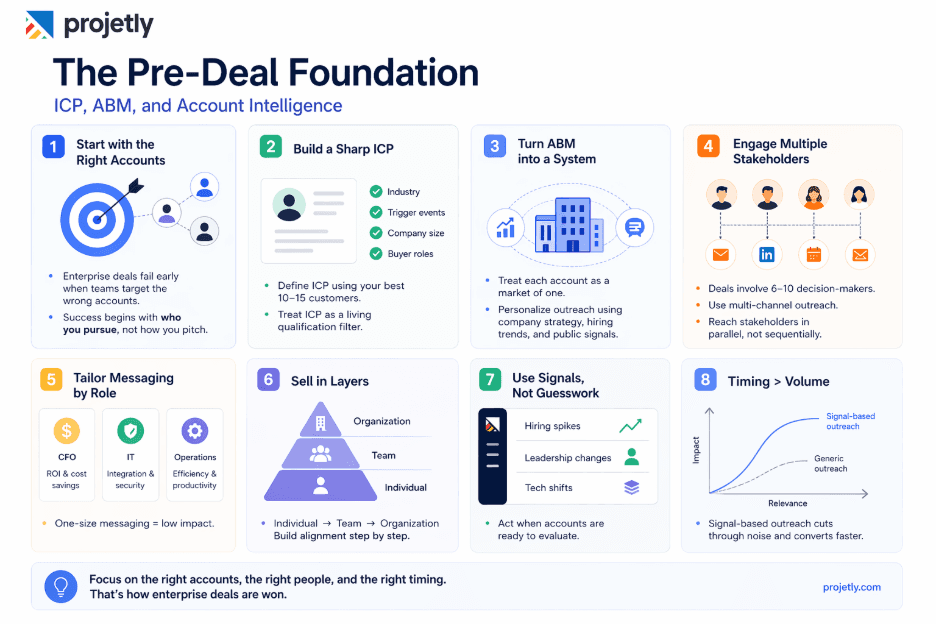
1. The Core Problem: Targeting the Wrong Accounts
Most failed enterprise deals don’t fail in the sales cycle; they fail at the targeting stage
Chasing poorly qualified accounts leads to wasted time, longer cycles, and low conversion
Strong enterprise sales start with who you choose to pursue, not how you pitch
2. Building a High-Quality Ideal Customer Profile (ICP)
An ICP is not a generic description; it’s a data-backed, evolving framework
Built from an analysis of your top 10–15 best customers
Key attributes to define:
Industry and vertical focus
Trigger events (e.g., funding, expansion, leadership change)
Company size and team structure at the time of purchase
Title and role of the internal champion
The ICP should act as a filter for all outbound and inbound efforts
3. From ICP to Execution: Making ABM Work
Once ICP is defined, Account-Based Marketing (ABM) becomes operational
Leading enterprise teams treat each account as a “market of one”
Outreach is built around account-specific context, not generic messaging:
Insights from earnings calls
Strategic initiatives and company priorities
Open job roles indicating internal focus areas
Focus shifts from “spray and pray” to precision targeting based on intent signals
4. Multi-Threaded, Multi-Channel Engagement
Enterprise buying groups typically include 6–10 stakeholders
Relying on a single channel (e.g., email) is ineffective
High-performing teams use a layered outreach strategy:
Email sequences
LinkedIn engagement
Executive briefings
Events or physical mail
Engagement happens simultaneously across multiple stakeholders
5. Role-Based Messaging (Why One Pitch Fails)
Each stakeholder evaluates your solution differently
Messaging must be customized by role:
CFO → Cost savings, ROI, financial impact
IT Leader → Integrations, security, technical feasibility
VP Operations → Efficiency, productivity, process improvement
A single generic pitch leads to low resonance across the buying group
6. The Three-Level Selling Framework
Enterprise deals require alignment across layers:
Sell to the individual (personal relevance)
Then to the team/department (functional value)
Finally, to the organization (strategic impact)
This layered approach ensures broader internal buy-in
7. Leveraging Sales Intelligence for Timing and Precision
Modern sales intelligence tools surface high-intent signals, such as:
Hiring surges, Leadership changes , and Tech stack shifts
These signals indicate when an account is:
Moving from awareness → active evaluation
Acting at the right moment:
Increases response rates
Shortens sales cycles
Cuts through noise better than cold outreach
8. Why Timing Beats Volume
Cold outreach without context is easy to ignore
Signal-based outreach is: More relevant , Better timed , and More likely to convert
Enterprise success is less about more activity and more about smarter entry points
Start your free trial and turn indecision into forward momentum.
Navigating the Buying Committee
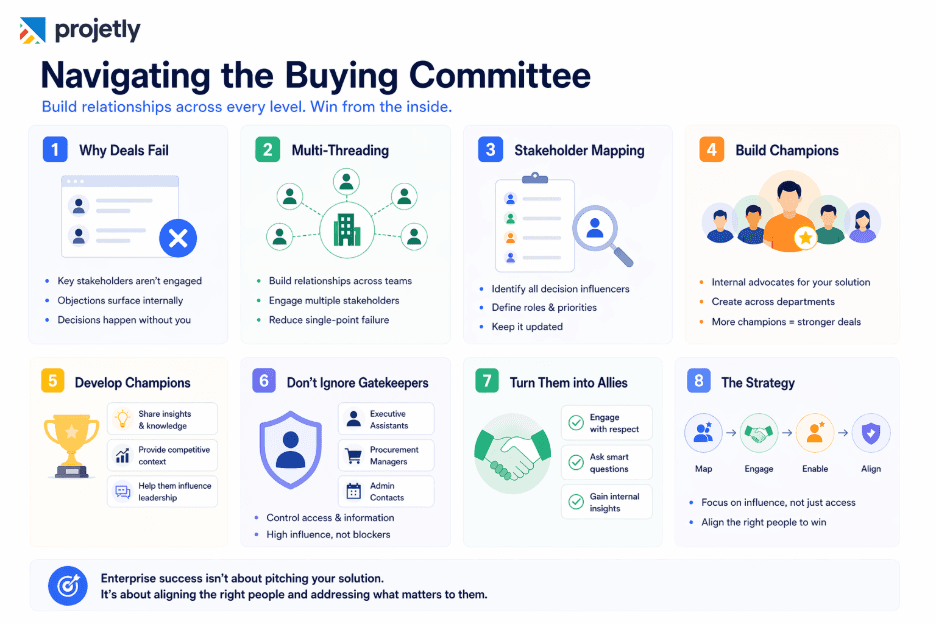
1. Why Deals Really Fail
Enterprise deals often don’t fail in meetings; they fail internally and invisibly
A key stakeholder: Was not engaged, Was not convinced
Quietly blocked the deal during internal discussions
The risk: Decisions happen when you're not in the room
2. The Solution: Multi-Threading
Multi-threading = building relationships across the entire buying group
It is: Deliberate, Systematic, Cross-functional
Goal: Ensure no single can derail the deal unnoticed
3. Start with Stakeholder Mapping
Identify all relevant players early in the cycle: Executives, Department heads, Influencers, Gatekeepers, Sceptics
For each stakeholder, define: Role in the decision: Key priorities, Level of influence
Communication approach
Treat this as a living map, not a one-time exercise
4. Build Multiple Champions (Not Just One)
Champions = internal advocates who:
Believe in your solution
Influence others when you're absent
Best practice:
a) Build multiple champions across departments
b) Why it matters:
One champion = single point of failure
Multiple champions = resilience during internal pushback
5. How to Develop Strong Champions
Goes beyond relationship-building
Focus on making them successful internally:
Share insights and industry knowledge
Provide competitive intelligence
Help them communicate value to leadership
Outcome: They gain credibility, and they become personally invested in your success
6. Don’t Ignore Gatekeepers
Common mistake: treating them as blockers
Reality: they are high-influence enablers
Includes: Executive assistants, Procurement managers
Admin contacts
They control: Calendar access, Information flow, and Executive perception
7. Turn Gatekeepers into Allies
Engage them with respect and intent
Ask thoughtful, relevant questions
Build trust early
Benefit:
a) Access to internal context and politics
b) Smoother navigation through the organization
c) Competitive advantage others don’t have
8. The Real Strategy
Map stakeholders → Build relationships → Enable champions → Partner with gatekeepers
Enterprise success depends on:
Coverage across the org
Influence, not just access
Contact us to bring structure and clarity to your enterprise deals.
Consultative Discovery: How to Find the Real Problem
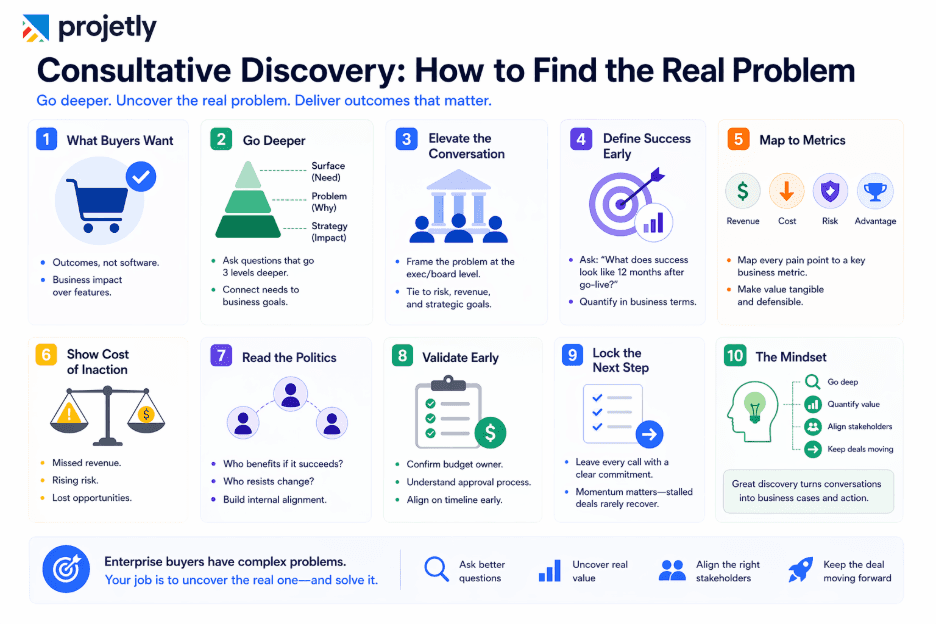
1. What Buyers Actually Purchase
Enterprise buyers don’t buy software
They buy outcomes and business impact
Biggest gap:
a) Stated need ≠ real problem
b) Deals are lost when reps:
c) Stay at surface-level requirements
d) Fail to connect to business outcomes
2. Go Beyond Surface-Level Discovery
Consultative discovery = dig 3 levels deeper
Move from:
a) Feature request → Use case → Strategic priority
b) Example breakdown:
c) “Better security reporting” (surface need)
d) → Audit risk exposure (functional problem)
e) → Regulatory liability (board-level issue)
Outcome: Shift from department spend → strategic investment
3. Anchor the Conversation at the Right Level
Position solutions at:
a) Executive/board level, not just team level
b) Connect every problem to: Business risk, Revenue impact, Strategic goals
c) Result: Higher urgency, Stronger deal justification
4. Define and Quantify Success Early
Ask: “What does success look like 12 months post go-live?”
Then:
a) Translate into measurable outcomes
b) Quantify in financial terms
c) Don’t wait for the buyer to define value; lead it
5. Tie Pain Points to Business Metrics
Map every issue to one of:
Revenue growth
Cost reduction
Risk mitigation
Competitive advantage
Why it matters:
Makes value tangible and defensible
6. Expose the Cost of Inaction
Identify: What happens if nothing changes?
Highlight: Hidden costs
Missed opportunities
Increasing risk over time
Insight: Inaction is often the strongest competitor
7. Understand Internal Politics
Identify: Who benefits if the project succeeds, and who may resist change?
Map: Influence and alignment
Helps: Navigate objections early, and build internal support
8. Validate Budget and Timeline Early
Confirm during discovery: Budget ownership, Approval process, and Procurement timelines
Avoid: Late-stage surprises
Stalled deals after months of effort
9. Always Secure a Clear Next Step
End every discovery call with: A defined commitment
Examples: Review case studies
Schedule a stakeholder meeting
Share internal data
Key principle: Momentum matters; stalled deals rarely recover
10. The Core Mindset
Go deeper → Quantify impact → Drive alignment → Maintain momentum
Great discovery turns: Conversations into business cases, and Interest into action
Contact us to turn better questions into better deals.
Pilots, Trials, and the Race to Value Realization
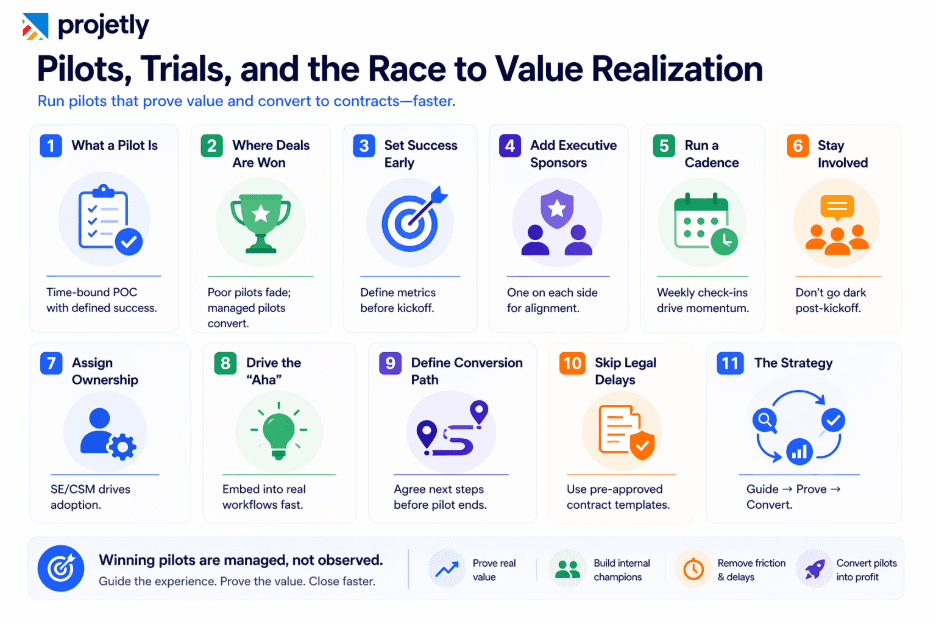
1. What a Pilot Really Is
Enterprise “trial” = structured pilot / POC
Time-bound
Defined success criteria
Runs in a real customer environment
Purpose: Validate real-world value, not just features
2. Where Deals Are Won or Lost
Pilots are a critical conversion stage
Outcomes depend on:
How actively the seller manages the experience
Risk: Poorly managed pilots fade out instead of converting
3. Elements of a High-Performing Pilot
Defined success metrics (before starting)
Named executive sponsor (both sides)
Weekly check-ins with the implementation team
Clear path to full contract after success
4. Define Success Before You Start
Align on: What success looks like, and how it will be measured
Avoid: Post-pilot ambiguity
Result: Faster decision-making, and Easier conversion
5. Stay Actively Involved
Biggest mistake: “Set it and forget it” after kickoff
Reality: Products rarely sell themselves in an enterprise
Required: Continuous guidance
Active engagement
6. Assign Dedicated Ownership
Ideal roles: Solutions Engineer and Customer Success Manager
Responsibilities: Support users, remove friction early, and drive adoption
7. Accelerate the “Aha Moment”
Help users: Discover key use cases
Integrate into real workflows
Impact: Faster value realization, and higher stickiness
Insight: The more embedded the product, the harder to walk away
8. Create a Clear Conversion Path
Define next steps before pilot ends: Pricing, scope, and timeline
Ensure: No confusion once success criteria are met
9. Avoid the Legal Bottleneck
Common issue: Contract review delays deals late-stage
Smart workaround: Ask if a pre-approved contract template exists
Then: Adjust only pricing, scope, timelines
10. Why This Matters
Benefits: Reduces legal back-and-forth, shortens sales cycle, and prevents last-mile deal stalls
Especially effective in: Large enterprises with slow legal queues
11. The Core Strategy
Define success → Guide experience → Drive adoption → Remove friction → Close fast
Winning pilots: Are managed, not observed
Start your free trial to eliminate ambiguity and showcase results early.
Precision Closing Techniques That Work in 2026
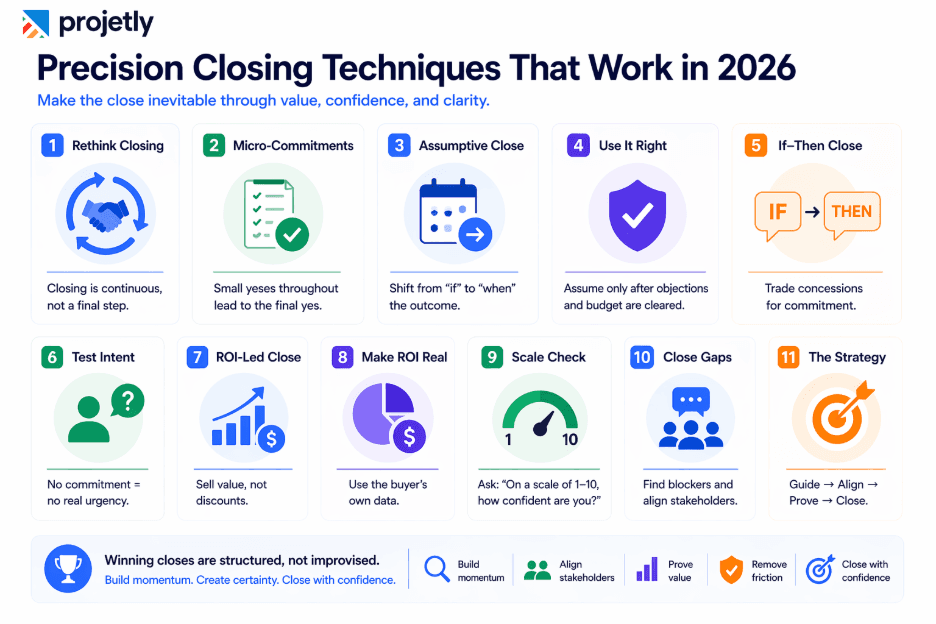
1. Rethinking Closing
Closing isn’t a final step
It’s a continuous process
Built through: Micro-commitments across the sales cycle
Insight: Strong deals feel inevitable, not forced
2. Continuous Micro-Commitments
Replace one big “close” with:
Small agreements at each stage
Examples: Next meetings, stakeholder alignment, pilot approvals
Result: Less friction at final signature
3. The Assumptive Close
Use when the buyer shows clear intent signals: Active engagement,
positive pilot feedback, and questions about implementation
Shift language: “When should we start?” vs “Do you want to proceed?”
Important: Only after objections + budget are fully addressed
4. When Assumption Backfires
Risk: Premature assumption = pressure
Objections
Budget authority
Goal: Make an assumption feel like a natural next step
5. The If–Then Commitment
Use when buyers request concessions:
Pricing, support, terms
Structure: “If we do X, can you commit to Y?”
Benefits: Prevents free giveaways and creates mutual accountability
6. Test Buyer Seriousness
If the buyer won’t commit in return:
Request may be: A delay tactic, not a real need
Insight: Real buyers exchange value for value
7. ROI-Led Closing
Use when price objections arise
Don’t: Default to discounting
Do: Reinforce business impact
Shift: Cost → Cost of inaction
8. Make ROI Credible
Build ROI using: Buyer’s own data
Avoid: Generic calculators
Outcome: Stronger trust and conviction
9. The Scale Check Technique:
Ask: “On a scale of 1–10, how confident are you?”
Purpose: Reveal hidden concerns
Rule: Anything below 9 = work to do
10. Diagnose Gaps Quickly
Follow-up questions: What’s missing? Who else needs alignment? And what makes it a 10?
Ask across: Multiple stakeholders
11. The Core Strategy
Build momentum → Trade value → Prove ROI → Remove friction → Close
Winning closes are: Structured, not improvised
Book a demo to see how top teams close complex deals with precision.
Security, Compliance, and Pricing Structure
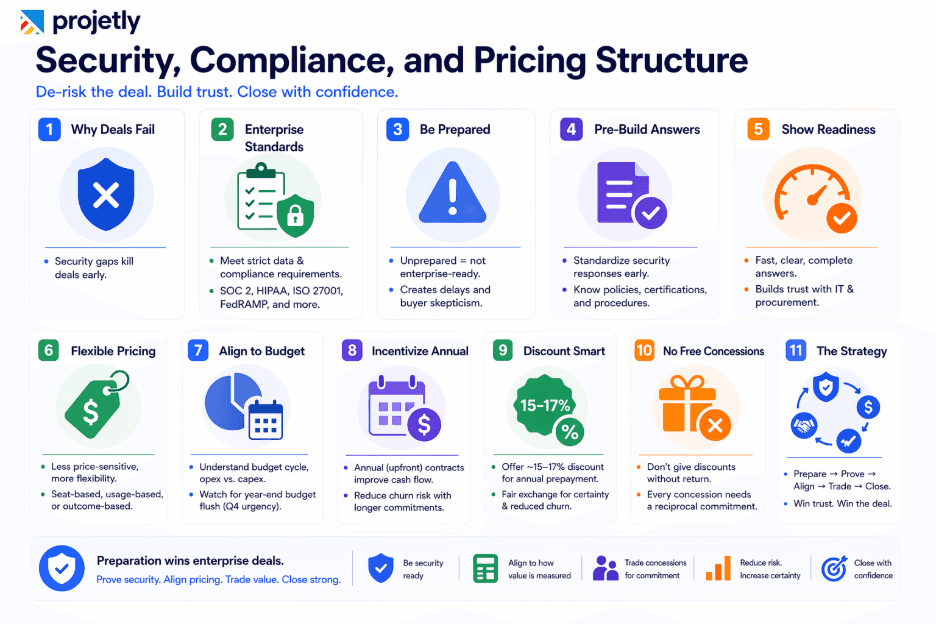
1. Why Deals Collapse
Security reviews are a top deal-breaker
Risks: Delays in procurement
Loss of buyer confidence
Signal: Lack of preparation = lack of enterprise readiness
2. Enterprise Security Expectations
Non-negotiable requirements:
Data residency
Access controls
Audit logging
Regulatory compliance
Common certifications: SOC 2, HIPAA, ISO 27001, and FedRAMP (industry-specific)
3. The Cost of Being Unprepared
Slows down deal cycles
Triggers deeper scrutiny from IT/security
Creates perception: “Not ready for enterprise scale”
4. Prepare Before the Review
Collaborate with: Legal team and security team
Build: Standard security questionnaire responses
Be ready to: Answer without constant escalation
5. Demonstrate Enterprise Readiness
Respond: Quickly, clearly, and completely
Impact: Builds trust with procurement & IT, and speeds up approvals
6. Pricing in Enterprise Deals
Less price-sensitive than mid-market
Requires: Flexibility, not rigidity
Common models: Seat-based, usage-based, and outcome-based
7. Align Pricing to Buyer Context
Understand: Budget cycle, Opex vs Capex preference, and Year-end budget dynamics (Q4 urgency)
Goal: Fit pricing to how value is measured internally
8. Incentivize Annual Commitments
Annual (upfront) contracts: Improve cash flow and reduce churn risk
Typical incentive: ~15–17% discount
9. Avoid Unconditional Discounting
Don’t: Give discounts without return
Always pair with: Faster implementation, case study/reference, signed timeline commitment
10. Trade Value for Value
Every concession should: Drive the deal forward
Principle: Mutual exchange, not one-sided giveaways
11. The Core Strategy
Prepare deeply → Prove security → Align pricing → Trade smart → Close confidently
Trust built in, start your free trial.
Metrics That Signal Deal Health
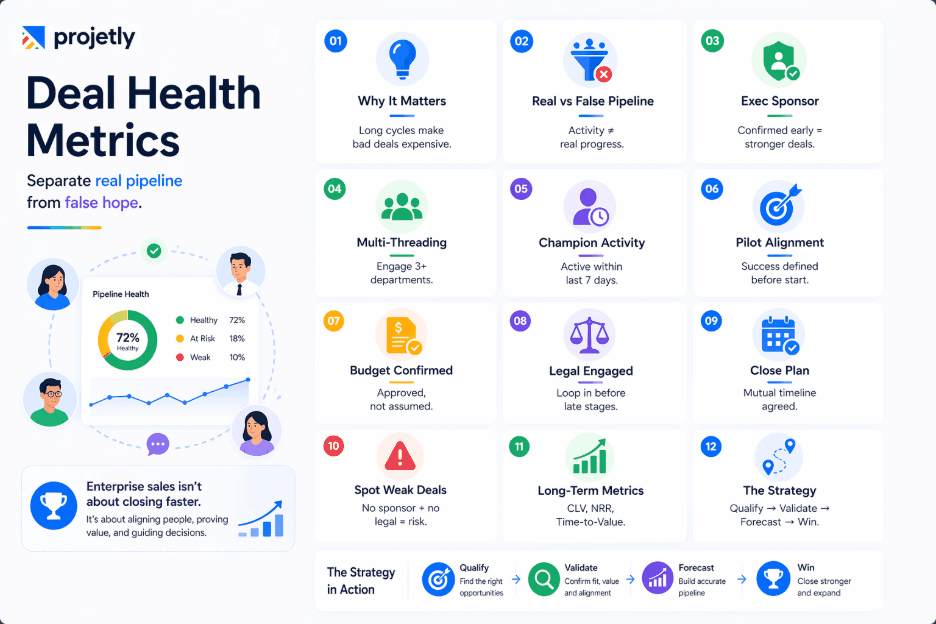
1. Why Deal Health Matters
Enterprise cycles are long and resource-heavy
Risk: Chasing deals that won’t close
Key skill: Distinguish a real pipeline from a false pipeline
2. The Core Question
Is this deal:
Genuinely progressing?
Or just appearing active?
3. Key Deal Health Signals
a. Executive Sponsorship
Confirmed executive sponsor
Established before Stage 2
b. Multi-Threading Depth
Engagement across:
At least 3 departments
c. Champion Activity
Active internal champion
Engaged within last 7 days
d. Pilot Alignment
Success criteria: Defined before the pilot starts, and not retrofitted later
e. Budget Confirmation
Budget: Clearly approved, not assumed
f. Legal & Procurement Involvement
Legal/procurement: Engaged early
Avoids: Late-stage delays
g. Mutual Close Plan
Shared plan: Agreed by both sides
Defines: Steps, timeline, ownership
4. Signals vs Checkboxes
Each metric is a signal of reality, not a task
Strong deal: Scores well across all signals
Weak deal: Looks active but lacks key alignment
5. Spotting False Pipeline
Warning signs: No executive sponsor, and no legal engagement in later stages
Insight: Activity ≠ progress
6. Forecasting Confidence
High-confidence deals: Strong across all signals
Low-confidence deals: Gaps in alignment or ownership
7. Beyond the Deal: Long-Term Metrics
a. Customer Lifetime Value (CLV)
Measures: Total revenue per customer
b. Net Revenue Retention (NRR)
Tracks: Expansion, churn, contraction
c. Time-to-First-Value (TTFV)
Measures: How quickly customers see value
8. Why These Metrics Matter?
Fast value realization: Drives renewals & expansion
Slow or no value: Leads to churn
9. The Enterprise Reality
One churned enterprise account can outweigh multiple new deals
Focus: Retention is as critical as acquisition
10. The Core Strategy
Qualify deeply → Track real signals → Forecast accurately → Drive value → Retain & expand
Book a demo and track what’s actually moving your deals forward.
The Bottom Line
Closing enterprise accounts in 2026 rewards a specific kind of discipline: deep discovery before any pitch, multi-stakeholder relationships built deliberately over time, a pilot experience managed actively rather than passively, and a closing motion calibrated to where the buyer is, not where you need them to be.
The deals that feel hardest to win usually aren't lost because of product or price. They're lost because someone within the buying organization lacked the information needed to move forward, and the seller never found out until it was too late. Let's build the process that prevents that from happening, and the close will take care of itself.
Stop losing deals late. Book a personalized call.
Frequently Asked Questions
How long does an enterprise SaaS sales cycle typically take?
Enterprise SaaS sales cycles typically last 6–24 months, depending on deal size, stakeholders, and complexity. High-value deals (>$100K ACV) average ~170 days, but multi-unit, customized, or regulated deals often take longer. Planning for 9–12 months is realistic.
What is the difference between enterprise SaaS sales and transactional SaaS sales?
Transactional SaaS deals typically involve one or two decision-makers, a sales cycle of days to a few months, and contract values under $50,000.
Enterprise SaaS involves 6–10 stakeholders, a cycle of 6–24 months, extensive customization requirements, strict compliance needs, and contract values that routinely reach six or seven figures. Enterprise deals also require dedicated customer success resources, structured pilots, and ongoing executive relationship management post-sale.
How do you build an internal champion in enterprise sales?
Building an Internal Champion
Make them successful in their role, not just sold on your product
Share valuable insights: competitive intel, research, best practices
Help them build a strong internal business case using their own data
Result: champions who win internally become invested in your deal
When should you say "no" to an enterprise prospect's feature request?
Say no when customization derails your roadmap, creates unreliable commitments, or serves only one customer. Ask: Does this benefit the broader market or add technical debt? Often, buyers still proceed without the custom feature.
What closing techniques work best for enterprise SaaS deals?
Use assumptive close (after clear intent), if–then commitments (trade concessions for timelines), ROI-led closing (reinforce value over price), and scale checks (surface hidden risks). Enterprise closing = continuous micro-commitments, not a final ask.
You may also like

A Guide to Project Management Professional Certification

Laugh Your Way to Productivity: 50 Workplace Quotes

50 Funny Workplace Memes That’ll Brighten Your Workday.
What Does a Customer-First Mindset Mean? Explained in 2025

What It Takes to be a Great Customer Success Manager in 2025