Digital Sales Room

By
Sammy Jones

How Digital Sales Rooms Help B2B Teams Close Deals Faster and With More Visibility
B2B sales have always been complex. But something has shifted fundamentally in the last few years: buying committees have expanded; sales deals that once involved five decision-makers now involve six to ten, and sales cycles routinely stretch across months.
The majority of that time? Buyers are working entirely without you. They're researching, deliberating, building internal consensus, all out of a seller's line of sight.
According to Gartner, roughly 90% of the B2B buying process happens without a seller in the room. Buyers are looping in colleagues, weighing alternatives, digging up emails from three weeks ago, and trying to piece together a coherent picture from information scattered across inboxes, shared drives, and Slack threads. It's a friction-heavy experience for everyone.
Digital sales rooms were built to solve exactly that. They give sellers a centralized, branded workspace where everything a buyer needs actually lives: content, conversations, next steps, stakeholder access, and engagement analytics, all in one place, buyers can return to on their own terms.
This guide covers everything B2B sales leaders, account executives, and revenue operations teams need to know about digital sales rooms in 2026.
Move beyond scattered emails and blind spots. Start a free trial and experience a better way to manage deals.
What is a Digital Sales Room?
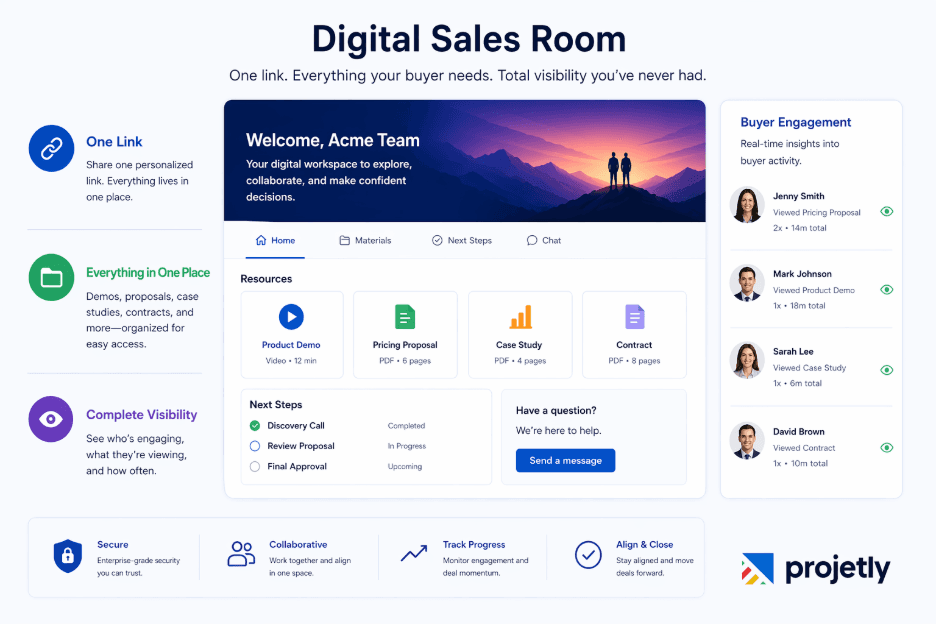
A digital sales room is a personalized, branded microsite a sales rep builds for a specific prospect or account. It replaces the fragmented back-and-forth of email-based selling with a single shared workspace where everything lives: demos, case studies, pricing proposals, contracts, and presentations.
But a DSR is more than a document repository. It also tracks buyer engagement, who viewed what, for how long, and how many times, giving sellers deal visibility that email simply can't provide.
Instead of a buyer tunnelling through 40 forwarded messages to find the proposal their CFO asked about, they open one link, and everything is there.
Quick definition: A digital sales room is a personalized, secure microsite where sellers and buyers collaborate, share content, track progress, and align on next steps throughout the B2B sales cycle.
Move beyond scattered emails, start a free trial and bring structure to your deals.
Why B2B Sales Teams Need DSRs in 2026
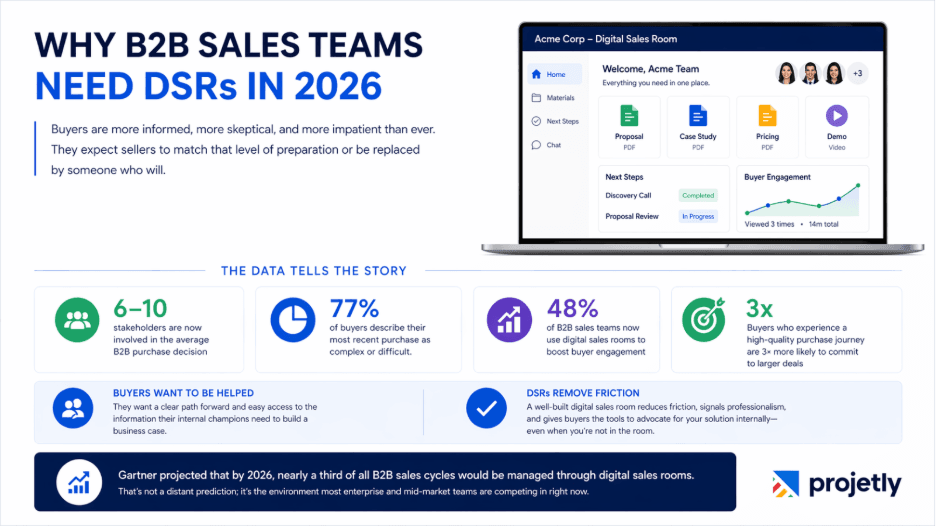
The pressure on B2B sales teams has never been higher. Buyers are more informed, more skeptical, and more impatient than they were even two years ago. They've done their research before the first call, and they expect sellers to match that level of preparation or be replaced by someone who will.
Key stats that frame the problem:
· 6–10 stakeholders are now involved in the average B2B purchase decision
· 77% of buyers describe their most recent purchase as complex or difficult.
· 48% of B2B sales teams now use digital sales rooms to boost buyer engagement
· Buyers who experience a high-quality purchase journey are 3× more likely to commit to larger deals
Beyond the numbers, there's a behavioral reality: buyers don't want to be sold to; they want to be helped. They want a clear path forward and easy access to the information their internal champions need to build a business case.
DSRs address exactly that. A well-built digital sales room reduces friction, signals professionalism, and gives buyers the tools to advocate for your solution internally, even when you're not in the room.
Gartner projected that by 2026, nearly a third of all B2B sales cycles would be managed through digital sales rooms. That's not a distant prediction; it's the environment most enterprise and mid-market teams are competing in right now.
Contact us to see how Digital Sales Rooms can support your sales process.
How A Digital Sales Room Actually Works
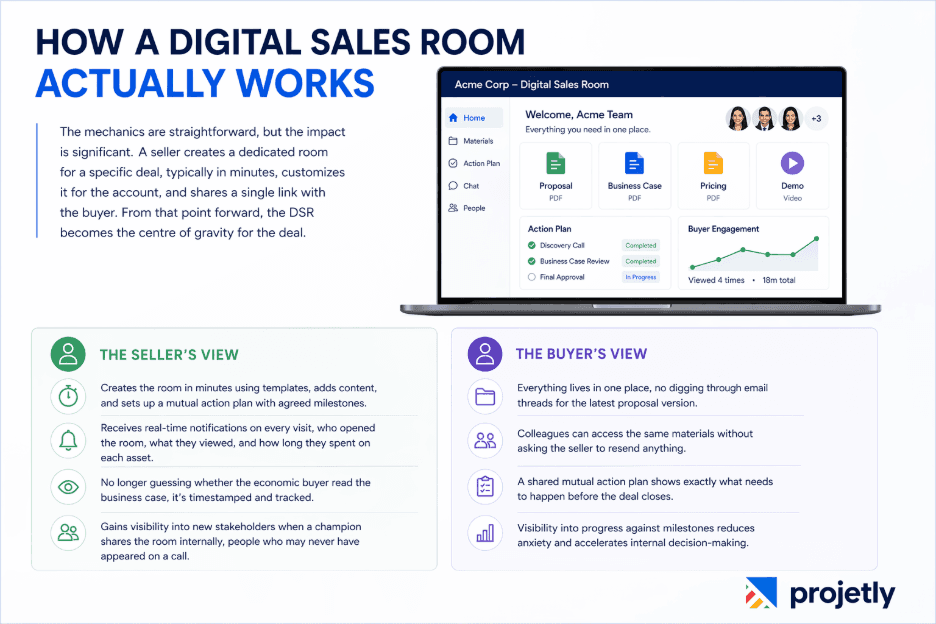
The mechanics are straightforward, but the impact is significant. A seller creates a dedicated room for a specific deal, typically in minutes, using templates, customizes it for the account, and shares a single link with the buyer. From that point forward, the DSR becomes the centre of gravity for the deal.
The seller's view
Creates the room in minutes using templates, adds content, and sets up a mutual action plan with agreed milestones
Receives real-time notifications on every visit, who opened the room, what they viewed, and how long they spent on each asset
No longer guessing whether the economic buyer read the business case, it's timestamped and tracked
Gains visibility into new stakeholders when a champion shares the room internally, people who may never have appeared on a call
The buyer's view
Everything lives in one place, no digging through email threads for the latest proposal version
Colleagues can access the same materials without asking the seller to resend anything
A shared mutual action plan shows exactly what needs to happen before the deal closes
Visibility into progress against milestones reduces anxiety and accelerates internal decision-making
See it in action for your own deals. Start a free trial.
5 Core Benefits That Accelerate Deal Cycles
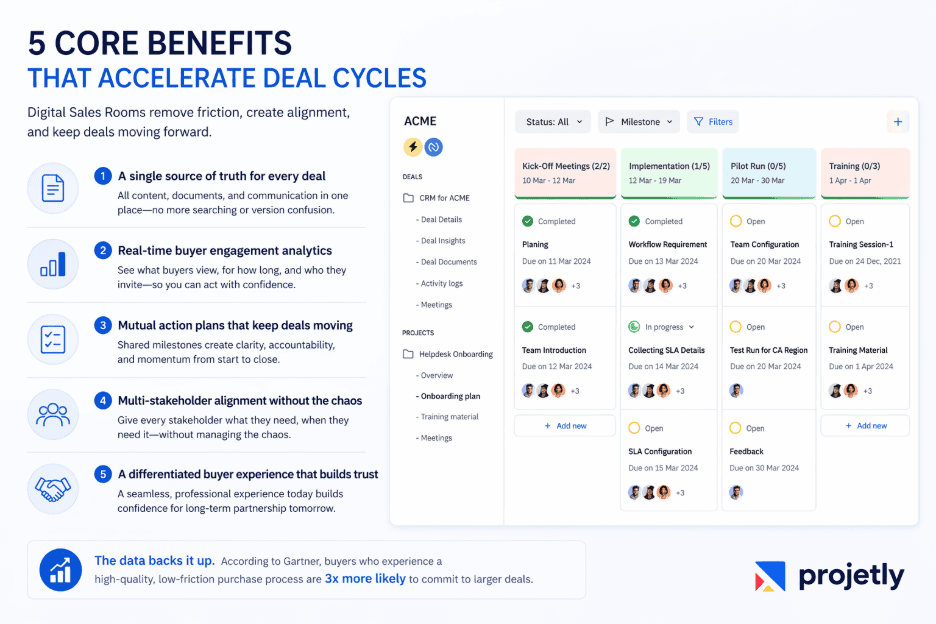
1. A single source of truth for every deal
Every piece of content, every document version, every communication thread, all in one accessible place. Sales cycles often stall not because buyers are uninterested, but because the information they need is buried or hard to find. A DSR removes that bottleneck entirely.
2. Real-time buyer engagement analytics
When a buyer opens a proposal at 11 pm on a Sunday and spends 18 minutes on the pricing page, that's a signal worth knowing about. When they share the room with four new email addresses, that's a signal too.
This intelligence transforms pipeline reviews; reps walk in with actual evidence of buyer behavior rather than gut feel, which sharpens prioritization, follow-up timing, and forecast accuracy.
3. Mutual action plans that keep deals moving
The best DSR platforms include built-in mutual action plan (MAP) functionality, a shared checklist of agreed milestones before closing, like security reviews, legal approvals, executive signoffs, and pilot scoping.
When these milestones live inside the room instead of a spreadsheet someone has to update manually, accountability improves on both sides and deals stay structured rather than drifting into “still evaluating” limbo.
4. Multi-stakeholder alignment without the chaos
Complex B2B deals routinely involve procurement, legal, IT, finance, and the end-user team, each with different concerns and different timelines. A DSR gives all of them one place to go, with content organized and accessible without any single person fielding every information request manually.
When a champion shares the room internally, the seller's tailored materials make the case on their behalf, reaching stakeholders they may never get on a call with.
5. A differentiated buyer experience that builds trust
How you sell signals, how you deliver. When a buyer experiences a well-organized, thoughtfully curated digital sales room, they form a strong impression about the team they'd be working with post-sale, and in deals where competing products are relatively similar in capability, that experience becomes a genuine differentiator.
The data backs it up. According to Gartner, buyers who experience a high-quality, low-friction purchase process are three times more likely to commit to larger deals.
Turn these advantages into faster, more predictable wins. Book a personalized demo.
Must-Have Features To Look For
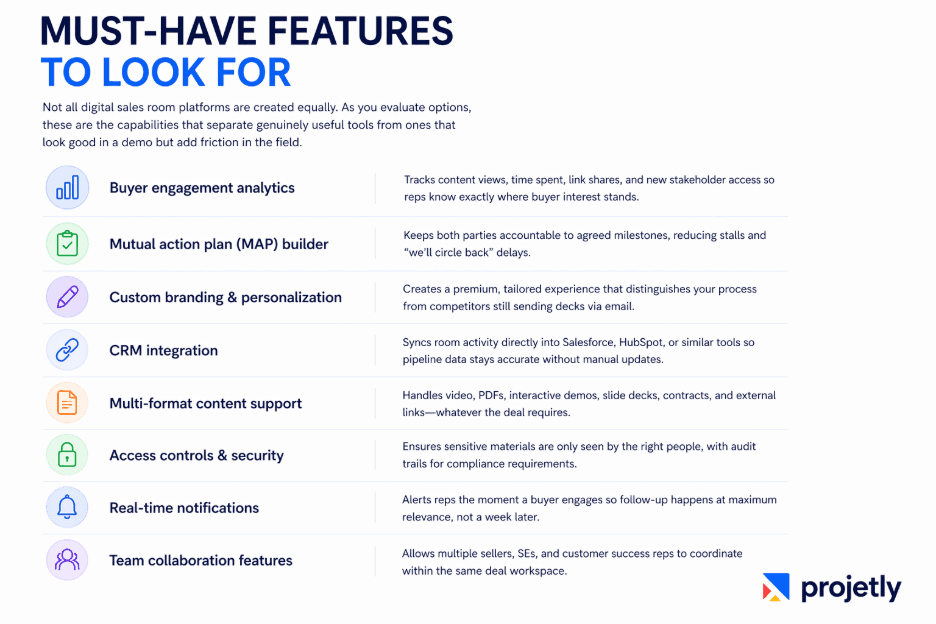
Not all digital sales room platforms are created equally. As you evaluate options, these are the capabilities that separate genuinely useful tools from ones that look good in a demo but add friction in the field.
· Buyer engagement analytics: Tracks content views, time spent, link shares, and new stakeholder access so reps know exactly where buyer interest stands.
· Mutual action plan (MAP) builder: Keeps both parties accountable to agreed milestones, reducing stalls and "we'll circle back" delays
· Custom branding & personalization: Creates a premium, tailored experience that distinguishes your process from competitors still sending decks via email
· CRM integration: Syncs room activity directly into Salesforce, HubSpot, or similar tools so pipeline data stays accurate without manual updates
· Multi-format content support: Handles video, PDFs, interactive demos, slide decks, contracts, and external links, whatever the deal requires
· Access controls & security: Ensures sensitive materials are only seen by the right people, with audit trails for compliance requirements
· Real-time notifications: Alerts reps the moment a buyer engages, so follow-up happens at maximum relevance, not a week later
· Team collaboration features: Allow multiple sellers, SEs, and customer success reps to coordinate within the same deal workspace.
Contact us to explore what a high-performing Digital Sales Room should look like.
DSR Vs. Traditional Email-Based Selling
Area | Digital Sales Rooms (DSRs) | Traditional Email-Based Selling |
Content Management | Single, centralized source of truth for all deal materials | Multiple versions of proposals and decks across email threads |
Stakeholder Access | All stakeholders access the same room anytime, no re-onboarding needed | New stakeholders must be manually onboarded via long email forwards |
Buyer Visibility | Real-time insights into who viewed what, and when | No visibility into whether materials were opened or shared internally |
Accountability | Built-in mutual action plans track next steps clearly for both sides | No structured tracking — next steps often drift or get lost |
Communication | All interactions and updates happen in one shared space | Conversations fragmented across email, Slack, LinkedIn, and calls |
Deal Progression | Structured, transparent, and easier to manage | Prone to delays, confusion, and “still evaluating” limbo |
Digital sales rooms eliminate each of these issues by design. The room is always current, always accessible, and always generating information the seller can act on; it's not a marginal improvement over email; it's a different category of selling tool altogether.
The Role of AI Inside Modern Digital Sales Rooms
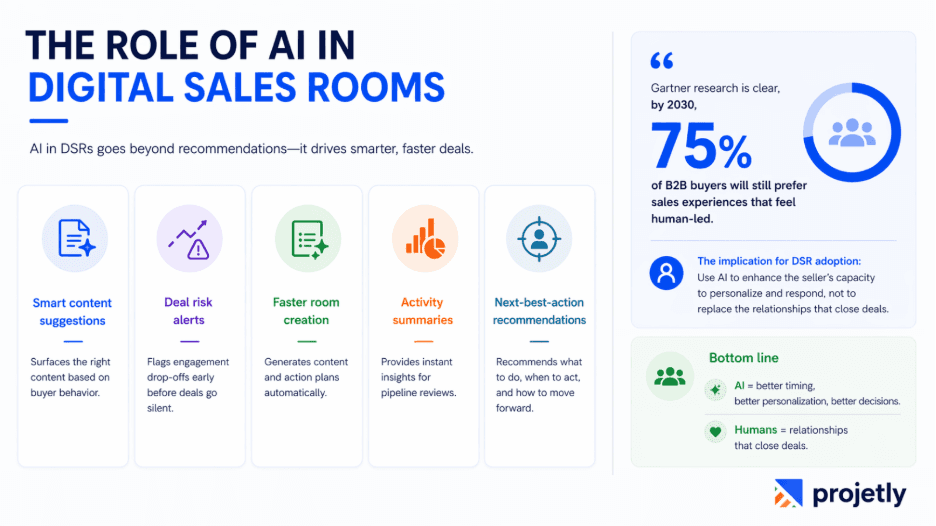
AI features inside DSRs now go well beyond simple content recommendations, advanced platforms analyze buyer engagement patterns and surface real-time next-best-action recommendations for sellers
If a buyer has spent significant time on a particular use case but hasn't seen the relevant customer story, the platform surfaces it proactively
If engagement drops off, AI-powered deal intelligence can flag a deal as at-risk before it goes quiet, giving managers an earlier warning than a missed forecast call ever would
AI is also increasingly used in room creation itself: generating personalised content, drafting mutual action plan items based on deal stage and industry, and summarizing buyer activity for pipeline reviews
That said, recent Gartner research is clear: by 2030, an estimated 75% of B2B buyers will still prefer sales experiences that feel human-led
The implication for DSR adoption: use AI to enhance the seller's capacity to personalize and respond, not to replace the relationships that close deals.
Put AI to work without losing the human edge. Start a free trial.
Real-World Use Cases By Sales Stage
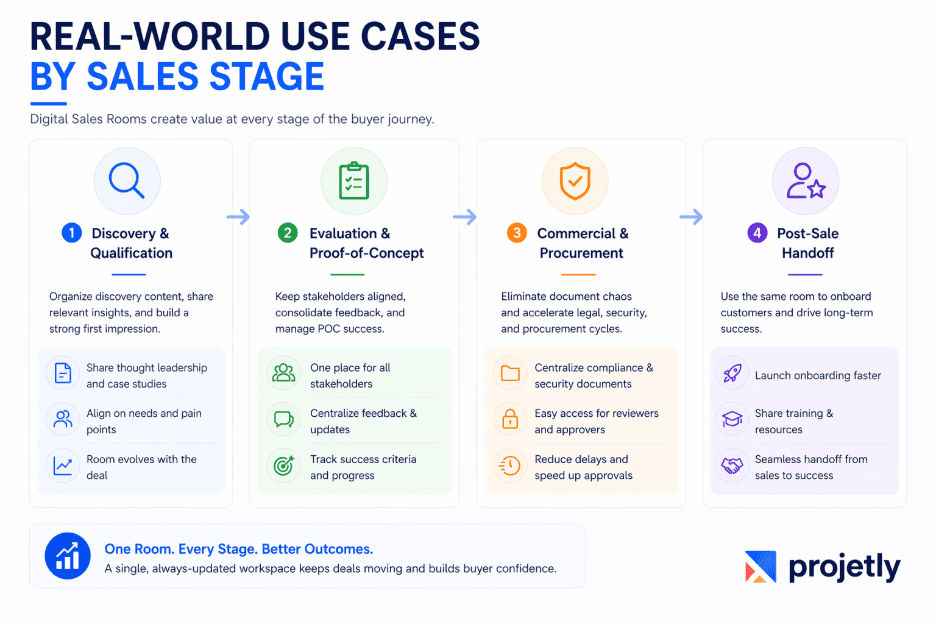
Discovery and qualification: Even in early-stage conversations, a DSR gives sellers a way to organize discovery content, share relevant thought leadership, and begin establishing a premium impression. A room created at this stage can evolve with the deal rather than being rebuilt from scratch later.
Evaluation and proof-of-concept: This is where DSRs deliver the clearest immediate value. POC-stage deals involve multiple stakeholders, significant documentation, and structured success criteria, and a DSR gives all parties a shared view of the evaluation framework, consolidates feedback, and ensures nothing important gets lost between meetings.
Commercial and procurement: Legal, security, and procurement processes are notoriously slow, but a significant part of that slowness comes from information being requested, sent, lost, re-requested, and resent. A DSR that keeps all compliance documentation, security questionnaire responses, and contractual materials organized and easily accessible can meaningfully accelerate this phase.
Post-sale handoff: Several DSR platforms now extend the room concept into customer onboarding and success. The same workspace used to close the deal becomes the foundation for onboarding, with implementation milestones, training materials, and customer success contacts all housed in a familiar environment, reducing the friction that often accompanies a CRM-to-CS handoff.
See how DSRs support every stage of your sales cycle. Book a personalized demo.
How To Choose The Right DSR Platform
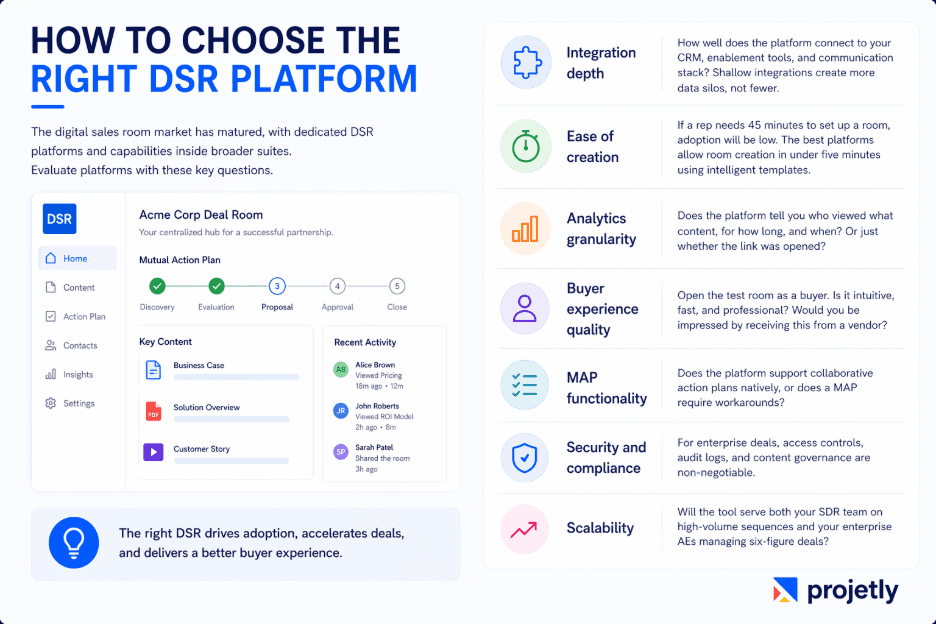
The digital sales room market has matured considerably, and there are now dedicated DSR platforms as well as DSR capabilities embedded within broader sales enablement suites. Choosing between them comes down to a few key questions.
· Integration depth: How well does the platform connect to your existing CRM, enablement tools, and communication stack? Shallow integrations create more data silos, not fewer.
· Ease of creation: If a rep needs 45 minutes to set up a room, adoption will be low. The best platforms allow room creation in under five minutes using intelligent templates.
· Analytics granularity: Does the platform tell you who viewed what content, for how long, and when? Or just whether the link was opened?
· Buyer experience quality: Open the test room as a buyer. Is it intuitive, fast, and professional? Would you be impressed by receiving this from a vendor?
· MAP functionality: Does the platform support collaborative action plans natively, or does a MAP require workarounds?
· Security and compliance: For enterprise deals, access controls, audit logs, and content governance are non-negotiable.
· Scalability: Will the tool serve both your SDR team on high-volume sequences and your enterprise AEs managing six-figure deals?
Leading platforms in the space include Projetly, Highspot, DealRoom, Trumpet, and GetAccept.
Each has different strengths depending on whether your priority is deep sales enablement integration, standalone simplicity, or advanced AI-powered deal intelligence.
Evaluate based on your current sales motion, not just a feature checklist.
Find the right fit for your team. Start a free trial.
Frequently Asked Questions
What's the difference between a digital sales room and a data room?
A data room (or virtual data room) is primarily a secure document repository used during M&A due diligence or fundraising, focused on access control and compliance. A digital sales room is a buyer-facing, collaborative workspace designed to facilitate and accelerate a B2B sales cycle. DSRs include engagement analytics, mutual action plans, and real-time collaboration tools that data rooms don't offer.
How long does it take to set up a digital sales room for a deal?
Most modern platforms allow reps to create a fully personalized DSR in three to five minutes using templates. More complex rooms for enterprise deals might take fifteen to twenty minutes to build the first time, but become faster as reps develop a repeatable process.
Do buyers actually use digital sales rooms, or do they just ignore the link?
Adoption varies by platform quality and how the room is introduced, but the data is generally strong. The key factor is how the seller frames the room in their initial outreach, positioning it as "one place for everything related to our evaluation", which tends to drive high uptake.
Can digital sales rooms work for short sales cycles as well as long enterprise deals?
Yes, though the ROI is most pronounced in complex deals with multiple stakeholders and long timelines. For shorter cycles, the main benefits are the professional impression created and the real-time engagement signals that allow faster follow-up. Many teams use lighter room templates for transactional deals and more comprehensive ones for strategic accounts.
How do digital sales rooms integrate with CRMs like Salesforce or HubSpot?
Most leading DSR platforms offer native CRM integrations that automatically log room creation, buyer activity, and engagement data as CRM activities, meaning deal records stay current without manual data entry, and managers can see buyer engagement signals directly in their pipeline views.
What content performs best inside a digital sales room?
Engagement analytics consistently show that video content, especially personalized video messages and product demo recordings, drives the highest engagement rates. Customer case studies relevant to the buyer's industry and company size also perform exceptionally well. Pricing proposals and ROI calculators attract the most revisits, which makes them excellent engagement signals to monitor closely.
You may also like

A Guide to Project Management Professional Certification

Laugh Your Way to Productivity: 50 Workplace Quotes

50 Funny Workplace Memes That’ll Brighten Your Workday.
What Does a Customer-First Mindset Mean? Explained in 2025

What It Takes to be a Great Customer Success Manager in 2025