
Customer onboarding toolkit
NEW CLIENT ONBOARDING

By
Dhruv
Unlocking Growth: How to Optimize Your B2B Customer Onboarding Journey in 2026
Here's an uncomfortable truth most B2B companies ignore: the moment a customer signs the contract is not when they commit to you. It's when they successfully use your product for the first time and feel like they made the right call.
That moment is owned entirely by your onboarding process.
In 2026, with buyer expectations higher than ever and competitive alternatives just a Google search away, a poorly executed B2B customer onboarding journey doesn't just slow growth, it actively kills it. Research consistently shows that customers who don't reach their first "aha moment" within the initial weeks are significantly more likely to churn before renewal.
The good news?
Most B2B companies still treat onboarding as an afterthought, which means getting it right is one of the most accessible growth levers available to you.
This guide breaks down everything you need: the step-by-step onboarding framework, best practices that actually move the needle in 2026, how to build the right team, what metrics to track, and the tools to make it all work at scale.
What Is a B2B Customer Onboarding Journey?
The B2B customer onboarding journey is the structured sequence of steps, interactions, and experiences a new customer goes through, from the moment they sign up or purchase your product until they're consistently using it to achieve their business goals.
It's not a single email. It's not a 15-minute product tour. It's an orchestrated, end-to-end experience designed to move customers from "I hope this works" to "I can't imagine working without this."
In B2B SaaS specifically, this journey often involves multiple stakeholders (champions, admins, end users), complex integrations, and a longer timeline than consumer onboarding. That's exactly why it requires a deliberate strategy, not a checklist you hand off to a junior CSM.
Book a demo → See how you can streamline onboarding from day one
Why a Well-Designed B2B Onboarding Journey Matters More in 2026
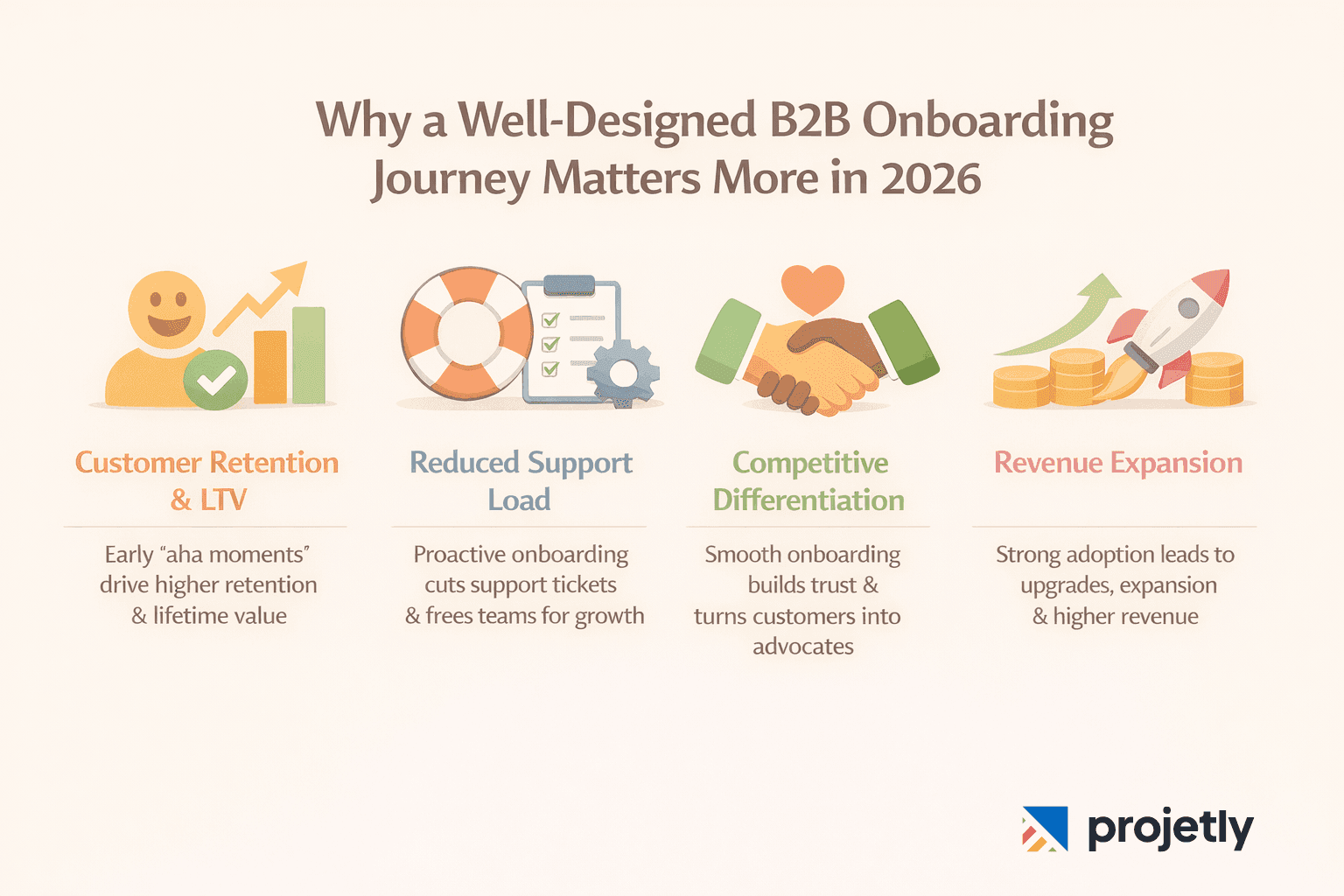
The business case for investing in B2B onboarding has only gotten stronger. Here's what's at stake:
Customer Retention & LTV: When users reach early “aha moments” quickly, they build confidence and momentum with your product, leading to higher retention and stronger lifetime value.
Reduced Support Load: Proactive onboarding, through self-serve resources, in-app guidance, and structured check-ins, reduces avoidable support tickets and frees teams to focus on strategic growth.
Competitive Differentiation: Onboarding is the first real proof of your product promise. A smooth, personalized experience builds trust early and turns new customers into advocates.
Revenue Expansion: Customers who successfully adopt your product are far more likely to expand into additional seats, features, or higher-tier plans, making onboarding a key revenue driver.
The 7 Core Stages of the B2B Customer Onboarding Journey
Every effective B2B onboarding process moves through these foundational stages. The specific touchpoints and timelines will vary by product complexity and customer segment, but skipping any stage creates gaps that tend to surface as churn later.
Stage | Focus | Key Challenge | Best Practice |
|---|---|---|---|
1. Sign-Up & Activation | First product experience | Friction causes early drop-off | Keep forms minimal, automate setup, get users into the product fast |
2. Welcome & First Touch | Set tone and expectations | Generic, overwhelming communication | Personalize welcome, assign CSM, clearly define next steps |
3. Setup & Configuration | Product readiness | Complexity kills momentum | Use guided, role-based setup tailored to user type |
4. First Value (“Aha Moment”) | Deliver initial success | Users don’t reach real value fast enough | Define key outcome and design onboarding to reach it quickly |
5. Education & Skill Building | Product adoption | Information overload | Introduce features progressively, start simple then expand |
6. Support & Self-Service | Ongoing momentum | Users get stuck post-onboarding | Provide proactive support + self-serve resources (chat, KB, guides) |
7. Feedback & Improvement | Optimization | Lack of actionable insights | Use NPS, surveys, and data to continuously refine onboarding |
B2B Customer Onboarding Best Practices for 2026
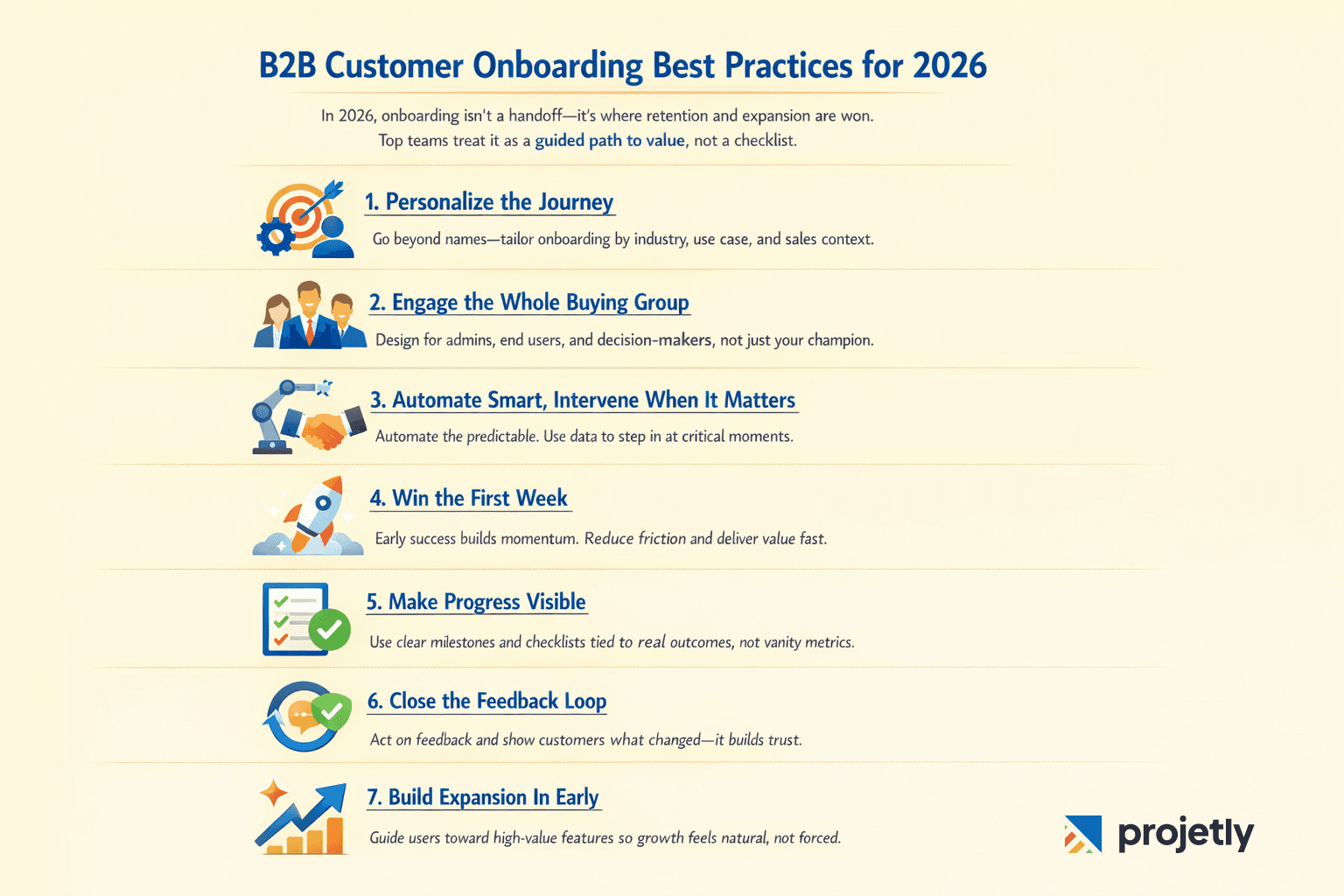
Best practices evolve. What worked in 2022 is table stakes in 2026. Here's what the highest-performing B2B onboarding teams are doing now:
1. Personalize the Entire Journey (Not Just the Greeting)
Basic personalization is expected. Real impact comes from tailoring onboarding to industry, company size, goals, and even sales context.
A fintech enterprise and an early-stage startup shouldn’t experience the same onboarding. The more relevant the journey, the faster customers reach value, and stay.
2. Design for Every Stakeholder, Not Just Your Champion
B2B onboarding involves multiple personas, each with different needs and levels of buy-in.
Your champion may be excited, but others may be skeptical or overwhelmed. Use role-based onboarding, targeted communication, and tailored experiences to bring everyone along.
3. Automate the Process, Humanize the Moments That Matter
Automation should handle the predictable, reminders, setup guidance, and content delivery.
But key moments need a human touch: executive check-ins, at-risk accounts, or complex blockers. The best teams use data and triggers to deploy human effort where it matters most.
4. Win the First Week
The first 7 days shape long-term perception. A strong start builds trust and momentum; a poor one creates lasting friction.
Focus on a structured kickoff, clear guidance, early success milestones, and at least one moment that exceeds expectations.
5. Show Progress, Don’t Just Track It
Progress visibility drives completion. Milestones, checklists, and subtle incentives help users move forward, especially in self-serve flows.
Keep it meaningful. Highlight real progress, not gimmicky achievements.
6. Close the Feedback Loop
Collecting feedback isn’t enough. Acting on it and communicating those changes builds trust.
When customers see their input lead to improvements, onboarding becomes a relationship, not just a process.
7. Tie Onboarding to Expansion from Day One
Onboarding and expansion shouldn’t be separate strategies.
Identify the features and behaviours that drive upgrades, and guide customers toward them naturally during onboarding. Done right, expansion becomes a byproduct of value, not a sales push.
Key Metrics to Measure B2B Onboarding Success
You can't optimize what you don't measure. These are the metrics that actually indicate whether your B2B onboarding is working:
Metric | What It Measures | Why It Matters |
|---|---|---|
Time to First Value (TTFV) | Time taken for a customer to achieve their first meaningful outcome | The most critical onboarding metric: faster TTFV = higher retention and success |
Activation Rate | % of users who complete onboarding milestones and start active usage | Low activation signals friction or confusion in onboarding |
Feature Adoption Rate | Which features new users are actually using | Low adoption indicates poor feature visibility or timing |
Onboarding Completion Rate | % of users who complete all onboarding steps | Helps identify drop-off points and optimization opportunities |
CSAT (Onboarding Exit) | Customer satisfaction at the end of onboarding | Reveals customer perception and highlights struggling segments |
Early Churn Rate | % of customers who churn within the first 90 days | Strong indicator of onboarding failure or lack of value realization |
Support Ticket Volume (First 30 Days) | Number of support requests during the onboarding period | High volume = friction points not addressed proactively |
NRR by Onboarding Cohort | Revenue retention segmented by onboarding experience | Shows the long-term impact of onboarding on expansion and retention |
Tools and Technologies for Optimizing B2B Onboarding in 2026
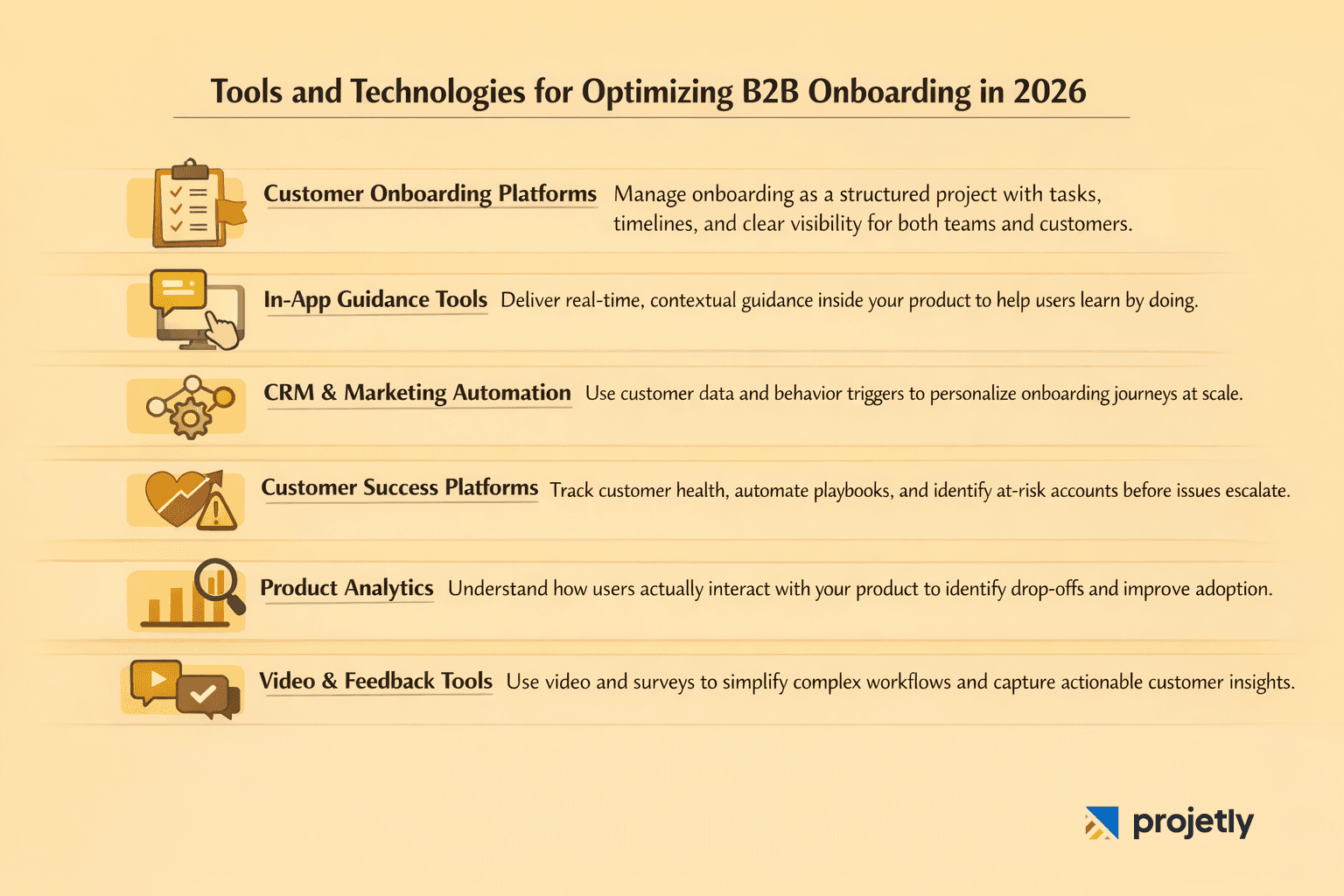
The tech stack for customer onboarding has matured significantly. Here are the key categories to consider:
Customer Onboarding Platforms: Tools like Projetly and Arrows provide purpose-built infrastructure for managing structured onboarding projects, customer-facing task lists, and progress tracking across complex B2B implementations.
In-App Guidance Tools: Platforms such as Pendo, Appcues, and WalkMe allow you to build interactive product tours, in-app tooltips, and contextual walkthroughs without relying on engineering resources for every change.
CRM and Marketing Automation: Salesforce, HubSpot, and Pardot (Marketing Cloud Account Engagement) are the backbone of personalized onboarding sequences. CRM data drives segmentation; automation delivers the right content at the right moment based on behaviour and lifecycle stage.
Customer Success Platforms: Gainsight, Totango, and ChurnZero provide health scoring, automated playbooks, and early-warning systems that help CSMs prioritize which accounts need attention before momentum stalls.
Product Analytics: Mixpanel, Amplitude, and Heap give you visibility into actual in-product behavior during onboarding: which features are being used, where users drop off, and how adoption patterns correlate with retention.
Video Platforms: Loom, Wistia, and Vidyard make it easy to create and deliver personalized video walkthroughs, a format that consistently outperforms written tutorials for complex product explanations.
Survey and Feedback Tools: Typeform, Delighted, and Medallia handle the collection side of customer feedback, while integrating with your CRM to connect sentiment data with account-level outcomes.
The right stack depends on your product complexity, team size, and the nature of your customer base. Start with the tools that address your most critical current gaps, typically either in-product guidance (if activation is low) or CRM automation (if personalization is inconsistent).
Book a Demo, See How We Make Customer Onboarding Effortless
Real-World Examples: What Effective B2B Onboarding Looks Like
Slack treats onboarding as product design, guiding users with contextual prompts so the product teaches itself.
HubSpot segments users by role from day one, delivering tailored onboarding so each persona sees only what’s relevant.
Dropbox focuses onboarding around one key action, uploading a file, making the product’s value instantly clear.
Intercom uses “success milestones” to unlock the product progressively, keeping onboarding focused and non-overwhelming.
The common thread across all of these: they reduce cognitive load, accelerate time to first value, and let the product demonstrate its worth rather than asking the customer to take it on faith.
Common Onboarding Challenges, and How to Address Them
"Customers aren't completing the onboarding checklist."
Break it into smaller, clearly sequenced steps. Reduce the number of required actions in the first session. Make it visually obvious how much progress has been made and what comes next. Consider removing steps that aren't genuinely necessary for initial success.
"We can't personalize at scale."
Start with two or three core segments rather than trying to build a hyper-personalized flow for every customer type. A few well-designed tracks based on industry or use case will outperform one generic track, and you can add more segments over time as you learn what works.
"Our onboarding is too long, and customers lose interest."
Audit your onboarding flow for every step that doesn't directly contribute to the customer's first value moment. If a step is about your product's features rather than the customer's outcomes, it probably belongs in a later education sequence, not in the critical first-week experience.
"Our CSMs are overwhelmed and can't give every new customer enough attention."
Use behavioral data and account health scores to triage. Accounts showing strong engagement and activation progress often don't need much human intervention. Free your CSMs to focus on accounts that are showing early warning signs, low login frequency, incomplete setup, or declining engagement.
"We're not sure what's actually causing early churn."
Run a cohort analysis: compare the onboarding behavior of customers who churned in the first 90 days versus those who retained. What did retained customers do in the first two weeks that churned customers didn't? Those behaviours are your activation milestones.
Still struggling to get customers on board smoothly? Book a 1-on-1 demo with our onboarding experts and find out what's holding you back.
Frequently Asked Questions
What is a B2B customer onboarding journey?
A B2B customer onboarding journey is the complete sequence of experiences and interactions a new business customer goes through after purchasing your product, from initial account setup through to confident, regular product use. It typically includes welcome communication, product setup, education, first value delivery, and ongoing support, all designed to help the customer achieve their desired outcomes as quickly as possible.
How long should B2B customer onboarding take?
It depends on product complexity, but a useful benchmark is 30–90 days for a structured onboarding program in B2B SaaS. More important than the total duration is achieving the customer's first meaningful outcome within the first 7–14 days; this early win significantly predicts long-term retention.
What is the most important metric for measuring B2B onboarding success?
Time to First Value (TTFV), how quickly a customer achieves a meaningful outcome after signing up, is generally considered the most predictive onboarding metric. It directly correlates with activation rates, customer satisfaction, and long-term retention.
How do you personalize B2B onboarding at scale?
By combining CRM data, sign-up survey responses, and behavioral triggers to segment customers into distinct onboarding tracks. Most companies start with two to four segments based on role, industry, or company size, and automate the delivery of segment-specific content through marketing automation and in-app guidance tools.
What is the difference between customer onboarding and customer success?
B2B Onboarding is the structured initial phase focused on getting a customer to their first successful outcome. Customer success is the broader, ongoing function responsible for ensuring customers continue to achieve value throughout the entire customer lifecycle. Onboarding is the critical foundation that makes effective customer success possible.
Does B2B onboarding fail?
The most common failure points: overloading customers with information too early, failing to personalize for different roles or use cases, not clearly defining the "aha moment" and building toward it, and treating onboarding as complete once the initial checklist is done, rather than as an ongoing relationship.
Stop Losing Customers at Onboarding. Try It Free for 14 Days.
Conclusion: Your Onboarding Is Your Brand Promise, Kept or Broken
Every B2B sale closes with an implicit promise: we'll help you succeed with this product. Your B2B onboarding journey is the first major test of whether you mean it.
The companies that get this right, that design onboarding as a strategic asset rather than an operational necessity, consistently outperform on retention, expansion revenue, and customer advocacy.
In 2026, with product-led growth strategies maturing and buyer expectations rising, the gap between companies with great onboarding and those without is only widening.
The framework is clear. The metrics are well-defined. The tools exist. The only question is whether you're willing to invest the attention onboarding actually deserves.
Start with your first value moment. Work backwards from there. Measure relentlessly. And iterate until getting your customers to success stops feeling like an uphill climb, and starts feeling like your best growth lever.
Looking to build a high-performance B2B onboarding program?
Explore our related resources on customer success strategies, onboarding team structures, and product adoption frameworks.
You may also like

A Guide to Project Management Professional Certification

Laugh Your Way to Productivity: 50 Workplace Quotes

50 Funny Workplace Memes That’ll Brighten Your Workday.
What Does a Customer-First Mindset Mean? Explained in 2025

What It Takes to be a Great Customer Success Manager in 2025