Digital Sales Room
NEW CLIENT ONBOARDING

By
Anuj

Sales to Customer Success Handoff Pain Points: How to Fix in 2026
Picture this: It's late Friday. Your best sales rep just closed a high-value deal, solid budget, multiple add-ons, and a champagne emoji in the Slack channel.
By Monday morning, the customer success manager opens the handoff email and finds a three-line summary, no discovery notes, a contract attachment, and a vague promise that "the client knows what they need."
Customer Onboarding stalls. The client starts calling their old sales rep for answers. The CSM is guessing expectations. And the trust you worked months to earn? It begins to crack in the first week.
This isn't a horror story. It's a Tuesday at most agencies and SaaS companies. According to research on handoff quality, a well-executed sales-to-CS transition makes a customer 3.5 times more likely to stay long-term. A poor one accelerates early churn faster than almost any other factor.
This guide breaks down every major handoff pain point, what causes it, what it costs, and how to fix it permanently.
Book a demo to fix broken handoffs and protect your revenue.
What is a Sales to Customer Success Handoff?
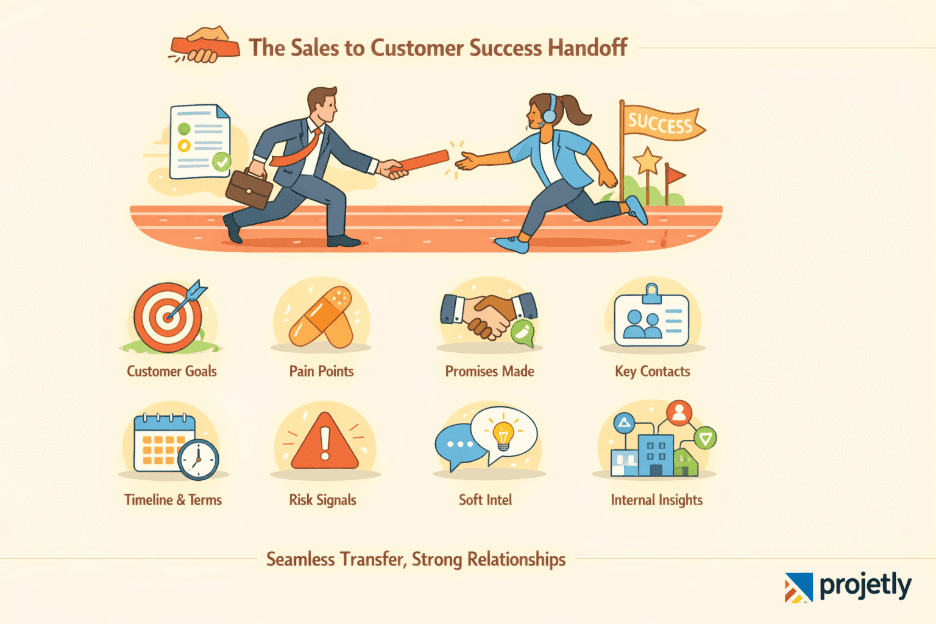
The sales-to-customer success handoff is the structured transfer of client ownership from the team that closed the deal to the team responsible for delivering it.
Think of it as a relay race baton pass. Sales buildmomentum through the finish line of the signed contract. Then the baton, all the context, promises, goals, nuances, and relationship intel, passes to customer success, who runs the next leg.
When that pass is clean, the customer barely notices the switch. They feel continuity. They feel cared for. When it's fumbled, everyone feels stumble, especially the client.
What gets transferred in a strong handoff:
Customer's core goals and success metrics
Pain points discovered during the sales process
What was promised (including any informal commitments)
Key contacts and decision-makers
Timeline expectations and contract terms
Risk signals and potential blockers
Soft intel: communication preferences, internal politics, sensitivities
The handoff isn't a document drop. It's a deliberate knowledge transfer that sets the tone for the entire customer relationship.
Why Handoffs Fail: The Root Causes Behind the Friction
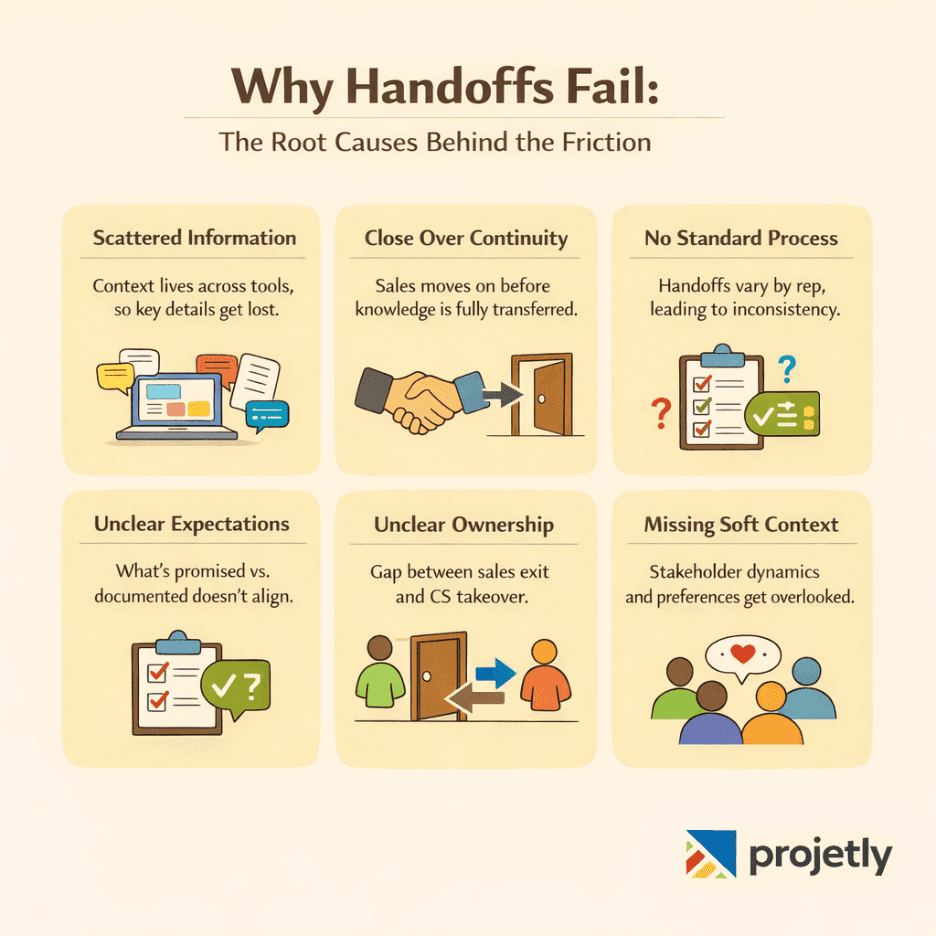
Before jumping to fixes, it's worth understanding why handoffs break down so consistently. The issues are rarely about effort; most sales reps want their clients to succeed. The breakdowns happen because of structural gaps.
1. Information lives in too many places: Customer context gets scattered across CRM notes, email threads, call recordings, Slack messages, and personal docs. No single source of truth means customer success has to piece together the story manually. Important nuances like why a feature mattered or what triggered urgency- often never make it through.
2. Sales optimizes for closing, not continuity: Sales teams are incentivized to win deals, not ensure smooth customer onboarding. Once the contract is signed, attention shifts to the next opportunity. Without a system that enforces knowledge transfer, critical insights stay in the rep’s head instead of being passed forward.
3. No standard handoff process: In many teams, handoffs depend entirely on individual habits. One rep might send a detailed Loom walkthrough, while another drops a one-line summary. This inconsistency creates unpredictable onboarding quality and forces CS teams to adapt every single time.
4. Missing or vague expectations: What the customer thinks they bought, and what’s documented, often don’t align. Verbal assurances, custom requests, or “we’ll figure it out later” promises rarely get captured clearly, leading to confusion, rework, and early trust issues.
5. No accountability for the transition: There’s often a grey area between “deal closed” and “onboarding started.” Sales assumes their job is done, while CS hasn’t fully taken ownership yet. Without defined responsibility, tasks fall through the cracks, and the customer feels the disconnect.
6. Soft context gets ignored: The most valuable insights are often the least documented, stakeholder dynamics, decision-making power, communication preferences, or internal resistance. These “human factors” shape the relationship, but rarely make it into formal handoff notes.
Handoff failures aren’t random; they’re systemic. When there’s no structured way to capture, standardize, and transfer context, even great deals start with friction.
See it live. Book your demo now.
The 6 Most Damaging Handoff Pain Points (and How to Fix Each One)
Issue | What Happens | Fix |
Information Gap | Missing context (goals, promises, preferences) | Add “soft intel” + auto-sync CRM & call notes |
Expectation Mismatch | Sales overpromises beyond delivery | Involve CS early + audit commitments |
Communication Gaps | No clear handoff or delayed responses | Standard handoff meeting + clear norms |
Abrupt Transition | Sales exits without proper intro | Warm intro + overlap in early calls |
Inconsistent Process | Every rep follows a different method | Standardize templates + automate workflow |
Unclear Ownership | No clarity on next-step responsibility | Define RACI + track accountability |
1. The Information Gap
What it looks like: The CSM opens the handoff and finds the basics, company name, contract value, and close date. What's missing: why the customer bought, what they're anxious about, what the sales rep promised verbally, and what "success" actually means to this specific client.
Real-world cost: Missing preferences lead to rework, a tense kickoff, and early damage to the client relationship.
The fix: Use a dynamic handoff doc with soft intel, require completion pre-close, auto-sync data, and train sales regularly.
2. Misaligned Expectations
What it looks like: Sales closes with "we can make that work" more than once. Customer success inherits a scope they can't deliver, a timeline that isn't realistic, or a feature commitment that doesn't exist yet.
Real-world cost: Overpromising leads to scope creep, unprofitable work, and CSMs stuck apologizing instead of delivering value.
The fix: Involve CS in proposals, run regular “promise audits,” and align KPIs to outcomes (NPS, onboarding), not just quota.
3. Communication Breakdown
What it looks like: There's no formal handoff meeting. The CSM emails the sales rep with questions. The rep is travelling. The kickoff stalls. The client starts following up, and no one has a clear answer about who's in charge.
Real-world cost: Delayed response and poor coordination make the client feel ignored and label the team as unresponsive.
The fix: Make handoff meetings mandatory, use async videos for context, assign a liaison for key accounts, and standardize communication norms.
4. The Abrupt Transition
What it looks like: The contract is signed, the sales rep disappears, and the client gets a calendar invite from someone they've never met. There's no warmth, no continuity, no explanation of what changes now.
Real-world cost: After months with sales, the client is left unsure who owns onboarding or their goals, turning a high-risk churn window into anxiety instead of confidence.
The fix: Make transitions visible with warm intros, involve sales early, add a “Meet Your CSM” video, and track transition NPS.
5. Inconsistent Process
What it looks like: Every handoff looks different depending on who's doing it. One rep uses Google Docs. Another uses Trello. A third sends a voice memo. The CS team spends the first week of every engagement just decoding what was handed to them.
Real-world cost: Inconsistent handoffs make onboarding quality a lottery; some clients get smooth transitions, others get chaos.
The fix: Standardize handoffs with a mandatory template in your CRM, automate triggers on deal close, and iterate based on onboarding metrics.
6. Unclear Ownership
What it looks like: Nobody is specifically assigned to follow up on pending items post-handoff. Compliance documents sit unsigned. Integration credentials aren't submitted. Week one passes, and nobody notices.
Real-world cost: A missing document delays kickoff, signals disorganization, and creates a poor first impression that’s hard to recover from.
The fix: Use a RACI dashboard with clear ownership, automate reminders, track on-time handoffs, and run regular cross-team check-ins.
Try free, build your first onboarding flow in 10 mins14-day trial.
The Sales-to-CS Handoff Process: A Step-by-Step Playbook
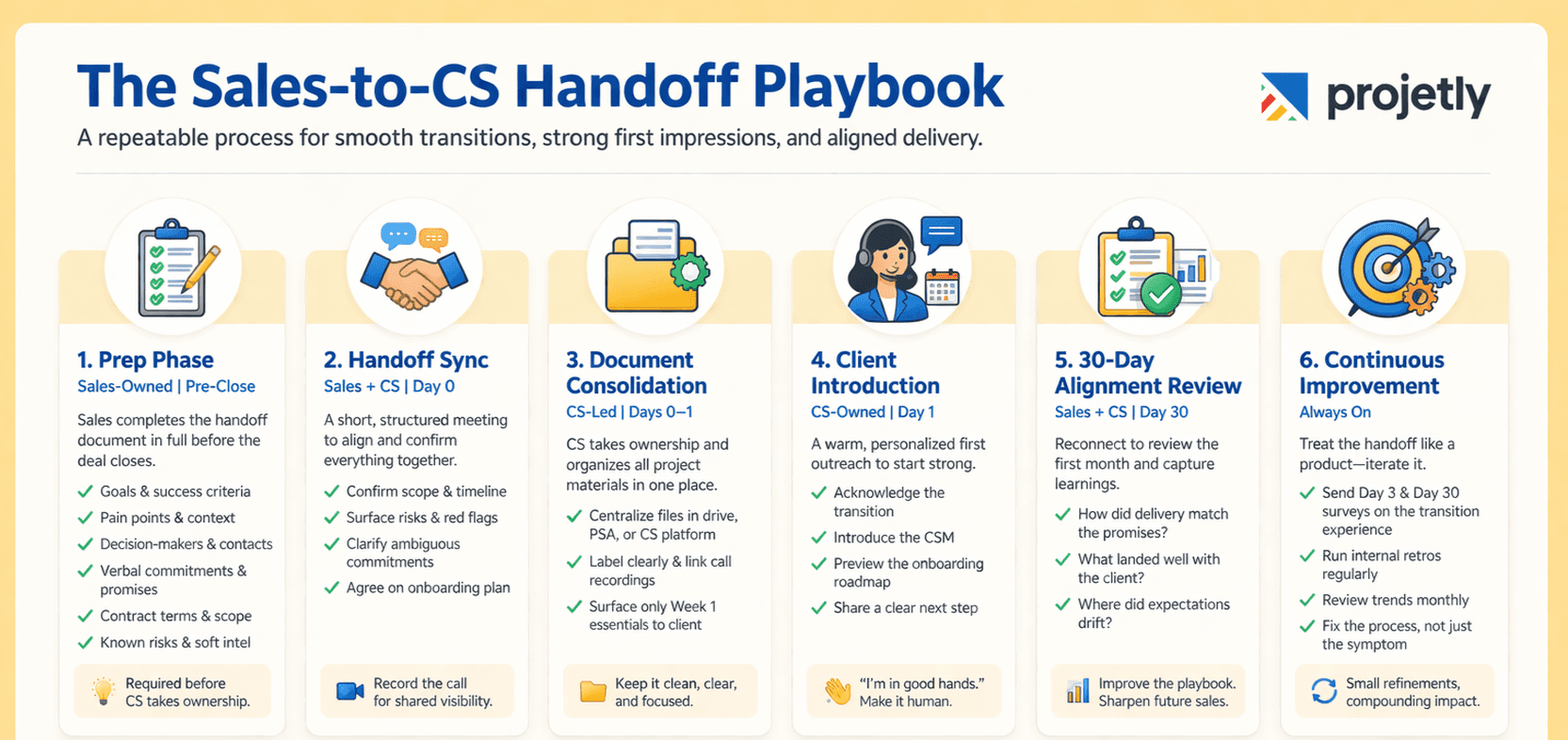
Fixing individual pain points helps. But what really transforms handoff quality is having a repeatable, documented process every team follows on every deal.
Step 1: Prep Phase (Sales-Owned | Days -2 to 0)
Before the deal officially closes, the sales rep completes the handoff document in full. This isn't a summary; it's a comprehensive transfer of everything the CSM needs: goals, pain points, decision-makers, verbal commitments, contract terms, known risks, and soft intel. The document is reviewed before CS takes ownership. Rushing this step is where most information gaps begin.
Step 2: Handoff Sync (Joint | Day 0)
A short, structured internal meeting between sales and CS to review the deal together. The group confirms scope, flags risks, clarifies any ambiguous commitments, and agrees on the onboarding plan. Recording this meeting gives anyone who missed it a reliable reference point. This single step eliminates the majority of "wait, what did sales promise?" moments.
Step 3: Document Consolidation (CS-Led | Days 0–1)
CS takes ownership of all project materials and organizes them into a clean workspace, whether that's a shared drive, PSA, or CS platform. Files are labelled clearly. Call recordings are linked. Only essential Week 1 information is surfaced to the client. Everything else lives in the background for reference.
Step 4: Client Introduction (CS-Owned | Day 1)
A warm, personalized outreach from CS on Day 1. This isn't a generic welcome email; it's a brief, human message that acknowledges the transition, introduces the CSM, previews the onboarding roadmap, and names a clear next step. Done well, this transforms the emotional experience from "I just signed, and now I'm confused" to "I'm in good hands."
Step 5: 30-Day Alignment Review (Joint | Day 30)
Sales, onboarding, and CS reconnect to review the first month. How did delivery align with what was sold? What did the client respond well to? Where did expectations drift? This review strengthens the playbook and gives sales insight into downstream outcomes, which in turn sharpens how they position and sell going forward.
Step 6: Continuous Improvement Layer
High-performing teams treat the handoff process like a product: always in iteration. Collect Day 3 and Day 30 client surveys, asking specifically about the transition experience. Run internal retros. Review trends monthly. If the same issue keeps surfacing, missing documentation, unclear timelines, abrupt transitions- fix the process, not just the individual case.
Talk to an onboarding expert, today
Best Practices That Separate Good Teams from Great Ones
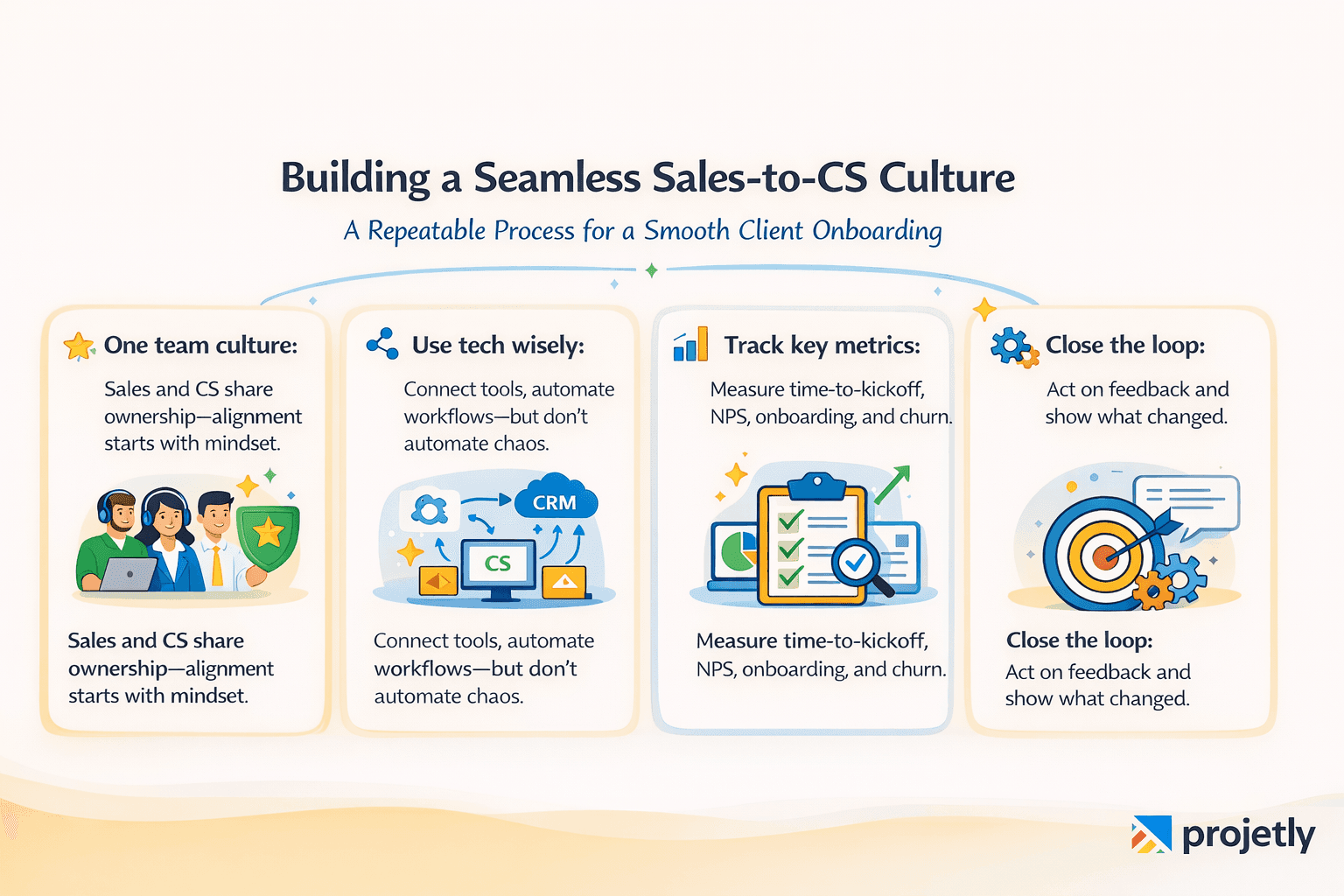
Build a "one team" culture: Sales and CS alignment isn't just a process problem, it's a culture problem. Cross-functional empathy, shared wins, and mutual understanding pressures matter as much as any tool or template. When teams see themselves as co-owners of the customer journey, handoffs improve organically.
Use technology deliberately: Your CRM should connect to your project management and CS platform. AI tools can summarize call recordings and flag key commitments automatically. Automation can trigger handoff tasks when a deal stage changes. But tools only work if the underlying process is solid; don't automate chaos.
Track the right metrics: Handoff quality should be measured, not assumed. Track time-to-kickoff, Day 30 NPS, onboarding completion rate, and 90-day churn on a per-rep basis. These metrics reveal where the process breaks and give you the data to fix it.
Make feedback loops real: Most feedback programs are performative; teams collect input and do nothing with it. The best organizations close the loop visibly: they announce what changed based on what customers and CS teams flagged. This builds buy-in and keeps the process evolving.
Got a complex onboarding challenge? Let's solve it.
Tools That Support a Strong Handoff Process
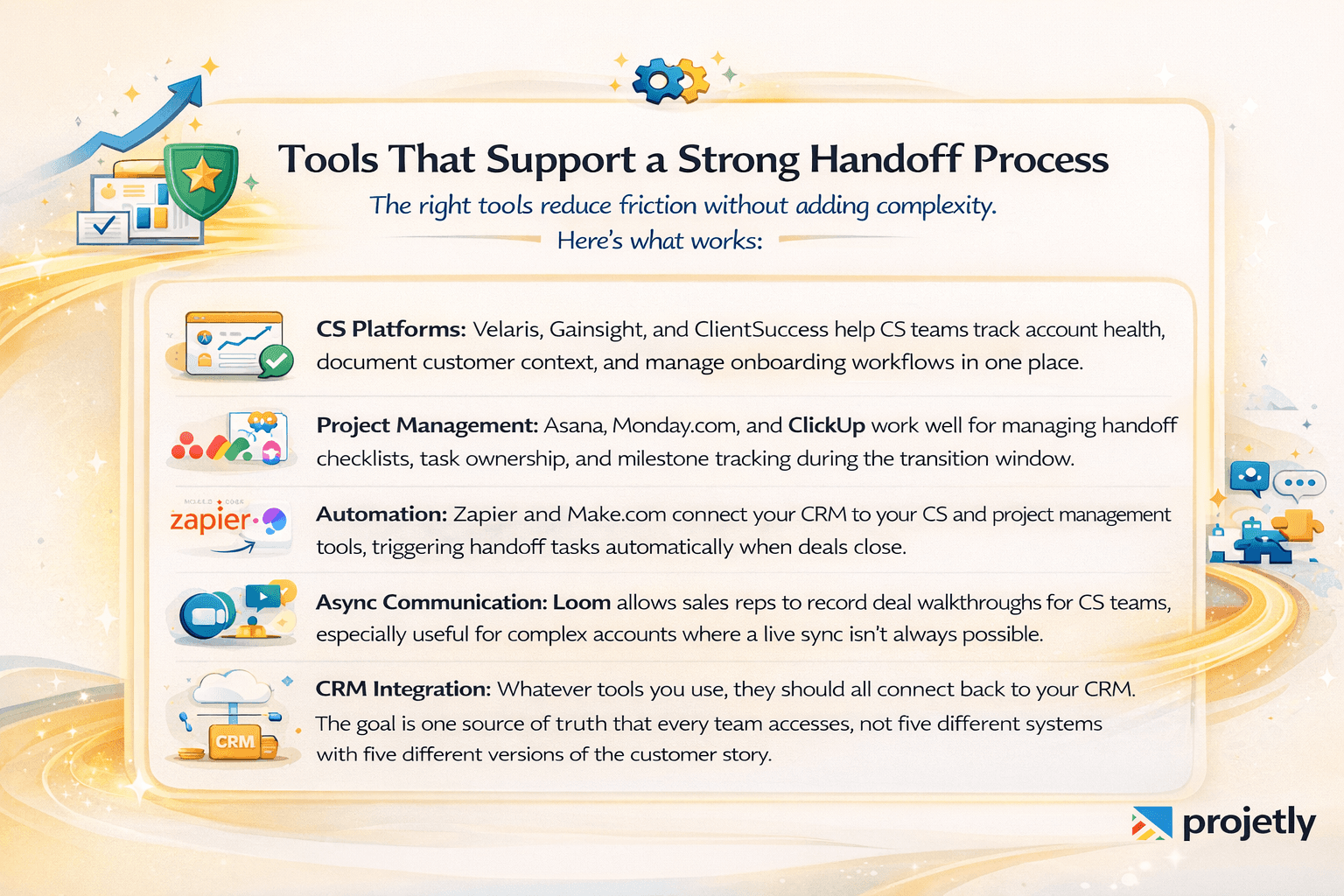
The right tools reduce friction without adding complexity. Here's what works:
CS Platforms: Velaris, Projetly, and ClientSuccess help CS teams track account health, document customer context, and manage customer onboarding workflows in one place.
Project Management: Asana, Monday.com, and ClickUp work well for managing handoff checklists, task ownership, and milestone tracking during the transition window.
Automation: Zapier and Make.com connect your CRM to your CS and project management tools, triggering handoff tasks automatically when deals close.
Async Communication: Loom allows sales reps to record deal walkthroughs for CS teams, especially useful for complex accounts where a live sync isn't always possible.
CRM Integration: Whatever tools you use, they should all connect back to your CRM. The goal is one source of truth that every team accesses, not five different systems with five different versions of the customer story.
Why This Matters for Long-Term Revenue
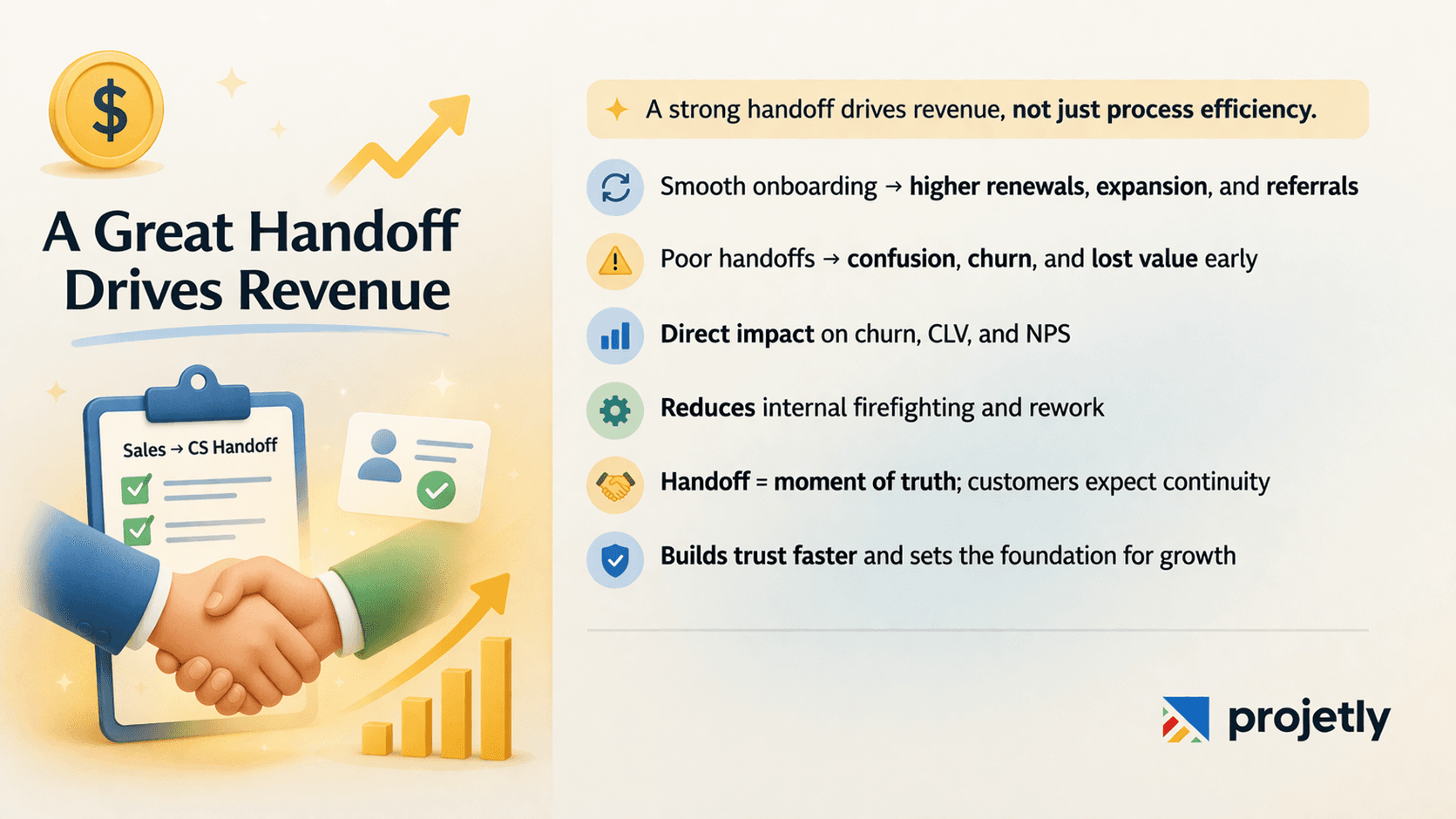
A great handoff isn't a nice-to-have. It's a revenue driver.
Customers who experience a smooth, confidence-building transition during onboarding are more likely to renew, expand, and refer. Those who experience confusion, gaps, or abrupt transitions are more likely to churn, often before they've had a chance to see real value from what they bought.
Fixing your customer handoff process directly impacts churn rate, customer lifetime value, and NPS. It also reduces the internal cost of firefighting: the hours CS spends chasing missing information, the tense client calls early in onboarding, and the damage control that follows a botched transition.
The handoff is a moment of truth. Most customers don't expect perfection; they expect continuity. They want to feel that the team they're working with actually knows who they are and what they need.
Get this right, and you don't just retain more customers. You start relationships on the right foot, build trust faster, and create the conditions for everything else, expansion, referrals, and case studies, to follow.
Reduce churn from day one, start your free trial
Frequently Asked Questions
What are the most common sales-to-CS handoff pain points?
The six most damaging handoff issues are information gaps, misaligned expectations, communication breakdowns, abrupt transitions, inconsistent processes, and unclear ownership. Most failed handoffs involve at least two or three of these simultaneously.
How early should customer success be involved in the sales process?
Ideally, CS should be looped in during the final stages of the deal, particularly when scope, timelines, and deliverables are being defined. The earlier CS understands what was promised, the smoother the transition.
What should a handoff document include?
A complete handoff document covers customer goals and success criteria, pain points identified in discovery, commercial and contract details, key contacts and decision-makers, implementation requirements, verbal or informal commitments, known risks, and communication preferences.
How do you measure handoff quality?
Key metrics include transition NPS (surveyed at Day 3 and Day 30), time-to-kickoff, onboarding completion rate, and 90-day churn by sales rep. These give you data to identify systemic issues in the handoff process, not just individual cases.
What's the fastest way to improve a broken handoff process?
Standardize the handoff template first. One repeatable format eliminates inconsistency immediately. Then add a mandatory internal sync before CS takes ownership. Those two changes alone tend to cut the most common friction points by half.
A well-run sales-to-customer success handoff isn't the final step in closing a deal. It's the first step in keeping a customer. Treat it accordingly.
You may also like

A Guide to Project Management Professional Certification

Laugh Your Way to Productivity: 50 Workplace Quotes

50 Funny Workplace Memes That’ll Brighten Your Workday.
What Does a Customer-First Mindset Mean? Explained in 2025

What It Takes to be a Great Customer Success Manager in 2025