BEST PRACTICES
NEW CLIENT ONBOARDING

By
Sammy Jones
Customer Onboarding Team Best Practices Guide 2026
A complete framework for reducing churn, accelerating time-to-value, and building lasting customer relationships
Customer onboarding is the structured process of guiding new customers from their first interaction with your product to becoming confident, active users who realize its full value. It is not just a welcome email or a quick product tour; it is the foundation on which every long-term customer relationship is built.
Done well, onboarding turns skeptical buyers into loyal advocates. Done poorly, it hands churn its easiest opportunity. In 2026, the bar is higher than ever: customers expect intuitive, personalized experiences from day one, and they have less patience for friction than at any point in the history of SaaS.
This guide gives your customer onboarding team a practical, field-tested framework, from team structure and role definitions to the metrics that matter and the tools that actually deliver results.
Quick Stat: Companies with a structured onboarding program report up to 50% higher product activation rates and a significant reduction in first-90-day churn compared to those without one. |
What is Customer Onboarding? (And Why It Matters in 2026)
Customer onboarding is the end-to-end process of helping a new customer get from purchase or sign-up to their first meaningful success with your product. It covers everything that happens between the moment they say yes and the moment they no longer need hand-holding, account setup, training, check-ins, milestone celebrations, and early support.
The definition sounds simple. The execution rarely is.
In 2026, customer onboarding matters more than ever for three compounding reasons:
• Competition has shortened attention spans. Users who don't see value within days, not weeks, are already comparing alternatives.
• AI-driven products have raised expectations. Customers now expect software to anticipate their needs, not just react to them. Your onboarding must reflect that intelligence.
• Retention economics are unforgiving. Acquiring a new customer costs five to seven times more than retaining one. A leaky onboarding process is one of the fastest ways to destroy unit economics.
Great onboarding is also your first and best opportunity to demonstrate the full value of what you sold. It sets the tone for every future interaction, creates the trust that enables upsell conversations, and generates the kind of early loyalty that turns into long-term revenue.
Book a demo to streamline your customer onboarding
The 5 Stages of an Effective Customer Onboarding Process
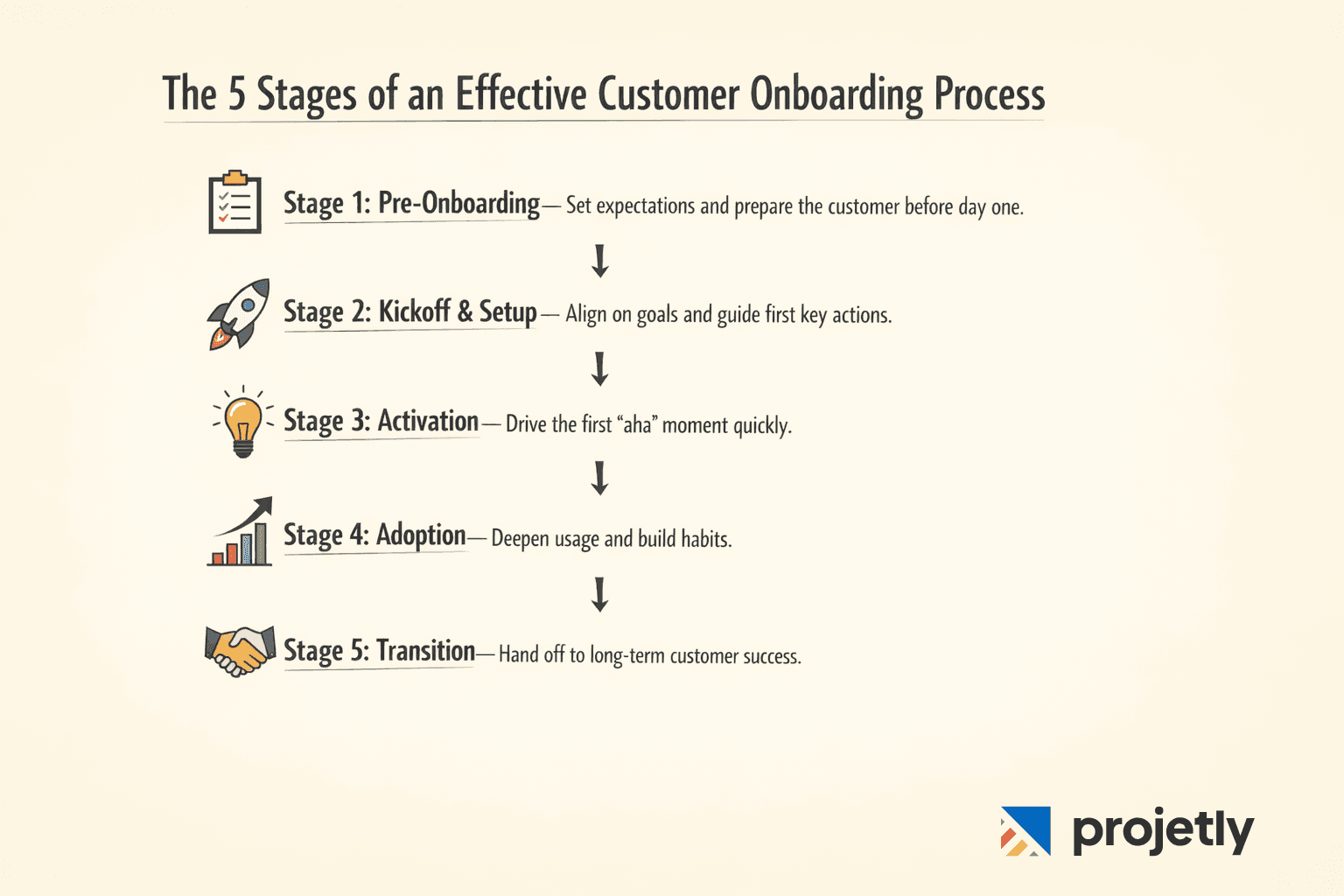
Most onboarding failures happen because teams treat it as a single event rather than a journey with distinct phases. Here are the five stages every customer moves through, and what your team needs to do at each one.
Stage 1: Pre-Onboarding (Before Day One)
Onboarding begins before the customer ever logs in. The pre-onboarding stage covers everything from the moment a deal is signed to first access. This is where expectations get set, and first impressions are made.
Send a personalized welcome email within 24 hours of signing, not a generic drip, but a message that references their specific use case and goals.
Share a clear onboarding roadmap so they know exactly what the next 30 days will look like.
Assign a named onboarding specialist so they have a real human to contact, not just a support queue.
Request kickoff call availability and pre-meeting questionnaire responses to personalize the first session.
Book a demo to deliver a seamless onboarding experience before day one
Stage 2: Kickoff and Account Setup
The kickoff is your highest-leverage moment. This is where you convert enthusiasm into momentum. The goal is not to show everything; it is to get the customer to one meaningful action as quickly as possible.
Run a structured kickoff call that covers their top 2-3 goals, not a feature walkthrough.
Complete the account setup together (or guide them through it live) so they don't encounter setup friction alone.
Identify and involve all key stakeholders early; onboarding that reaches only one contact person is at risk.
Define what "success" looks like for this specific customer and document it.
Stage 3: Product Activation and First Value
This is the most critical window in any B2B onboarding program. Time-to-first-value (TTFV), how quickly a customer achieves a meaningful outcome, is the single strongest predictor of long-term retention. Your job here is to remove every barrier between the customer and their first "aha" moment.
Build a guided checklist of 5-7 actions that lead to the first value, not 30 features.
Use in-app tooltips, interactive walkthroughs, and contextual help to reduce friction without requiring human intervention every time.
Celebrate first milestones, a notification, a congratulatory email, or a quick message from the CSM goes a long way.
Nail onboarding before day one. Start a free trial
Stage 4: Ongoing Training and Adoption Deepening
Once a customer achieves first value, the risk of churn drops significantly, but it doesn't disappear. The next phase is about expanding usage, building habits, and deepening their investment in your product.
Run regular check-in calls (weekly in the first month, bi-weekly in month two, monthly thereafter for most accounts).
Share a curated learning path of tutorials, webinars, and knowledge base articles relevant to their role and goals.
Track feature adoption data and proactively reach out when key features remain unused; don't wait for them to ask.
Introduce advanced capabilities only after foundational adoption is established.
Stage 5: Transition to Customer Success
B2B Onboarding is not a permanent state. The goal is to successfully transition the customer from "new" to "confident and self-sufficient," and then hand them off to your customer success team with full context.
Define a clear graduation criterion: what does a customer need to have achieved before onboarding officially ends?
Hold a formal handoff meeting between the onboarding specialist and the assigned CSM with the customer present.
Document all customer goals, preferences, pain points, and wins in the CRM for full continuity.
Send a graduation recap email summarizing what was accomplished and what comes next.
Book a demo to turn first impressions into long-term success
How to Structure Your Customer Onboarding Team
The structure of your customer onboarding team will depend on your company size, customer segment, and product complexity. But certain roles and responsibilities are universal to any high-performing onboarding function.
Core Roles and Responsibilities
Role | Core Responsibilities | Key Outcome Owned |
Onboarding Manager | Sets strategy, tracks team KPIs, ensures alignment between onboarding and Sales/CS/Product, and manages escalations. | Overall onboarding health score |
Onboarding Specialist | Primary customer contact during onboarding; runs kickoff calls, training sessions, and milestone check-ins. | Time-to-first-value, activation rate |
Technical Onboarding Engineer | Handles complex integrations, data migrations, SSO setup, and technical configuration for enterprise accounts. | Technical readiness, setup completion |
Customer Success Manager (CSM) | Receives the customer post-onboarding; maintains the relationship and drives long-term expansion. | Retention rate, NRR |
Onboarding Content Specialist | Creates and maintains training materials, video walkthroughs, knowledge base articles, and onboarding playbooks. | Self-serve adoption, support ticket deflection |
Start your free trial and set the right expectations from day one
Onboarding Team-to-Customer Ratios
A common question is how many customers one onboarding specialist can handle simultaneously. The answer varies by product complexity and segment:
High-touch enterprise onboarding: 5-10 accounts per specialist
Mid-market onboarding (mix of live and digital): 20-40 accounts per specialist
SMB / product-led onboarding (primarily self-serve with check-ins): 60-100+ accounts per specialist
As you scale, invest in digital onboarding tools, automated sequences, in-app guidance, and self-serve resources to maintain quality without linearly increasing headcount.
12 Customer Onboarding Best Practices for 2026
These are the practices that consistently separate high-retention onboarding programs from average ones. They're built on what the best teams in B2B SaaS, enterprise software, and customer success have learned from thousands of onboarding cycles.
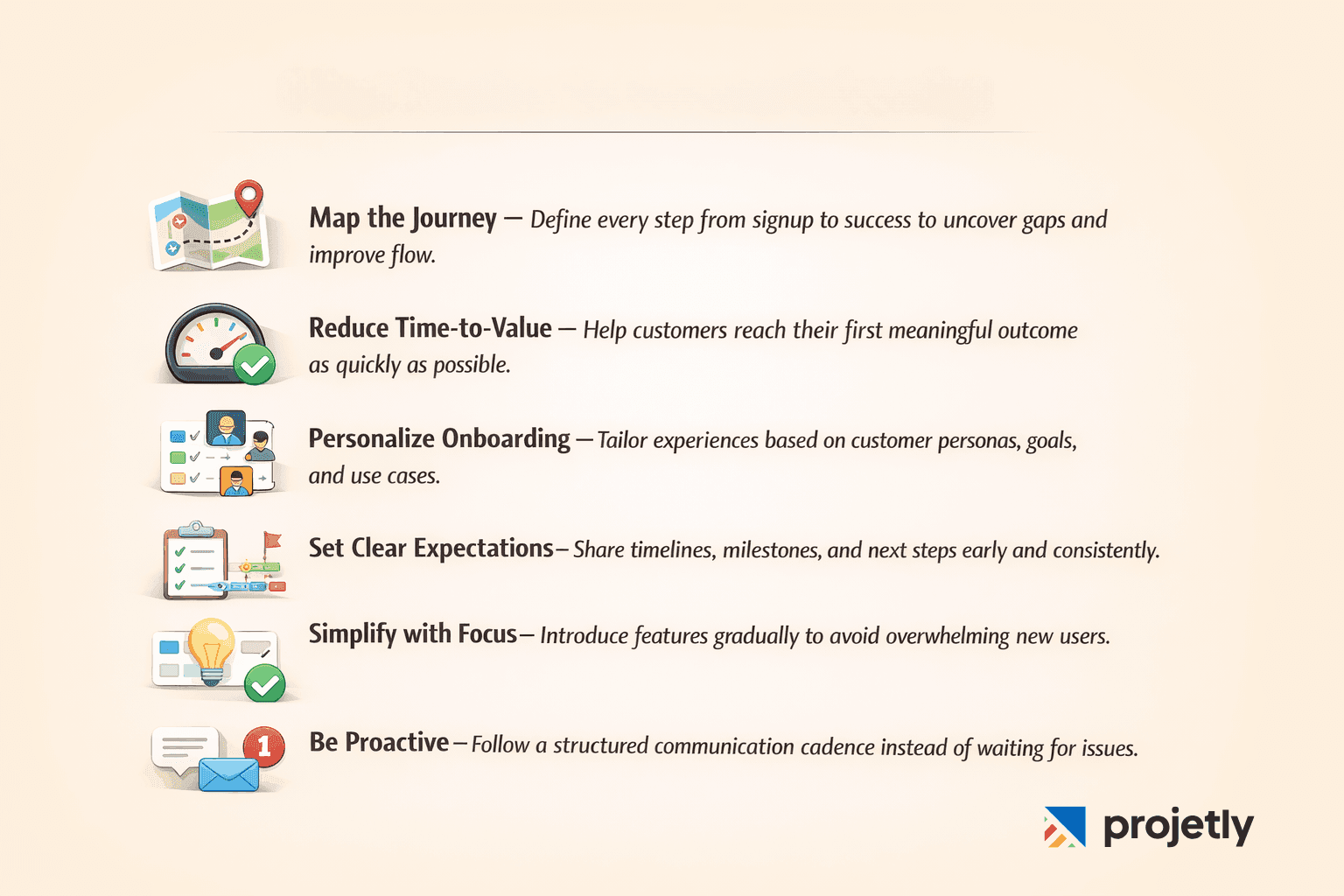
1. Map the Customer Journey Before You Start
Before you send a single email or schedule a single call, document every step the customer will take from sign-up to success. A journey map makes invisible assumptions visible, and it reveals the gaps where customers fall through the cracks.
Your journey map should cover every touchpoint, who owns it, what the customer needs to feel and do at each stage, and what triggers the next step. It should be a living document, updated quarterly as you learn more about where customers struggle.
2. Shrink Time-to-First-Value Relentlessly
If there is one metric your onboarding team should obsess over, it is time-to-first-value (TTFV), the time between account creation and the customer achieving their first meaningful outcome. Research consistently shows that customers who hit their first milestone quickly are dramatically more likely to retain.
Audit your current onboarding flow and ask: what is the one thing a customer needs to do to see value? Then remove every step between signup and that thing. Eliminate optional setup steps. Pre-fill what you can. Guide, don't overwhelm.
Practical tip: Define "first value" precisely for each customer persona. For a project management tool, the first value might be creating and assigning a first task. For a CRM, it might be importing contacts and logging a first activity. The specificity matters. |
3. Personalize Based on Customer Personas and Goals
Generic onboarding is a fast path to churn. Customers who feel like they're getting a one-size-fits-all experience disengage quickly, because they don't see themselves in what you're showing them.
Segment your customers into 3-5 personas based on company size, industry, primary use case, or technical sophistication. Then build distinct onboarding tracks for each segment. At minimum, this means different kickoff call agendas, different recommended first steps, and different milestone definitions. At best, it means entirely tailored learning paths and custom onboarding timelines.
Use the pre-onboarding questionnaire to assign customers to the right track automatically.
Train your specialists to adapt their communication style and depth to each persona.
Personalize welcome emails, in-app messages, and training recommendations using CRM and product usage data.
Get in touch to improve your onboarding experience. Contact us Today
4. Set Clear Expectations Early and Often
Onboarding anxiety is real. New customers often wonder: Am I doing this right? How long will this take? What happens next? The antidote is radical transparency about the process.
Share a visual onboarding roadmap on day one that shows every milestone, who's responsible for each, and the expected timeline. Send a weekly summary of what was accomplished and what comes next. Never let a customer wonder where they stand.
5. Use Progressive Disclosure, Don't Show Everything at Once
One of the most common onboarding mistakes is overwhelming new users with every feature, integration, and capability on day one. Progressive disclosure is the antidote: introduce your product in layers, revealing complexity only after the basics are mastered.
Start with the three to five core workflows that deliver the most immediate value. Only surface advanced features once foundational behaviors are established. This approach reduces cognitive load, builds confidence, and keeps customers engaged through a natural sense of progression.
6. Build a Proactive Communication Cadence
Reactive onboarding, waiting for customers to raise issues, is a retention risk. By the time a customer reaches out with a problem, they've often already decided to leave. Proactive communication flips this dynamic.
Build a structured communication cadence for every account: a kickoff call, a 7-day check-in, a 30-day progress review, and a 60-day milestone check. Between these touchpoints, monitor product usage data and trigger automated outreach when warning signs appear, such as accounts that haven't logged in, features that haven't been activated, or usage that's dropped below a threshold.
Use your CRM and customer success platform to automate low-touch outreach for SMB accounts.
Reserve high-touch check-ins for enterprise accounts or those showing early churn signals.
Always give communication a human feel; even automated messages should be personal and specific.
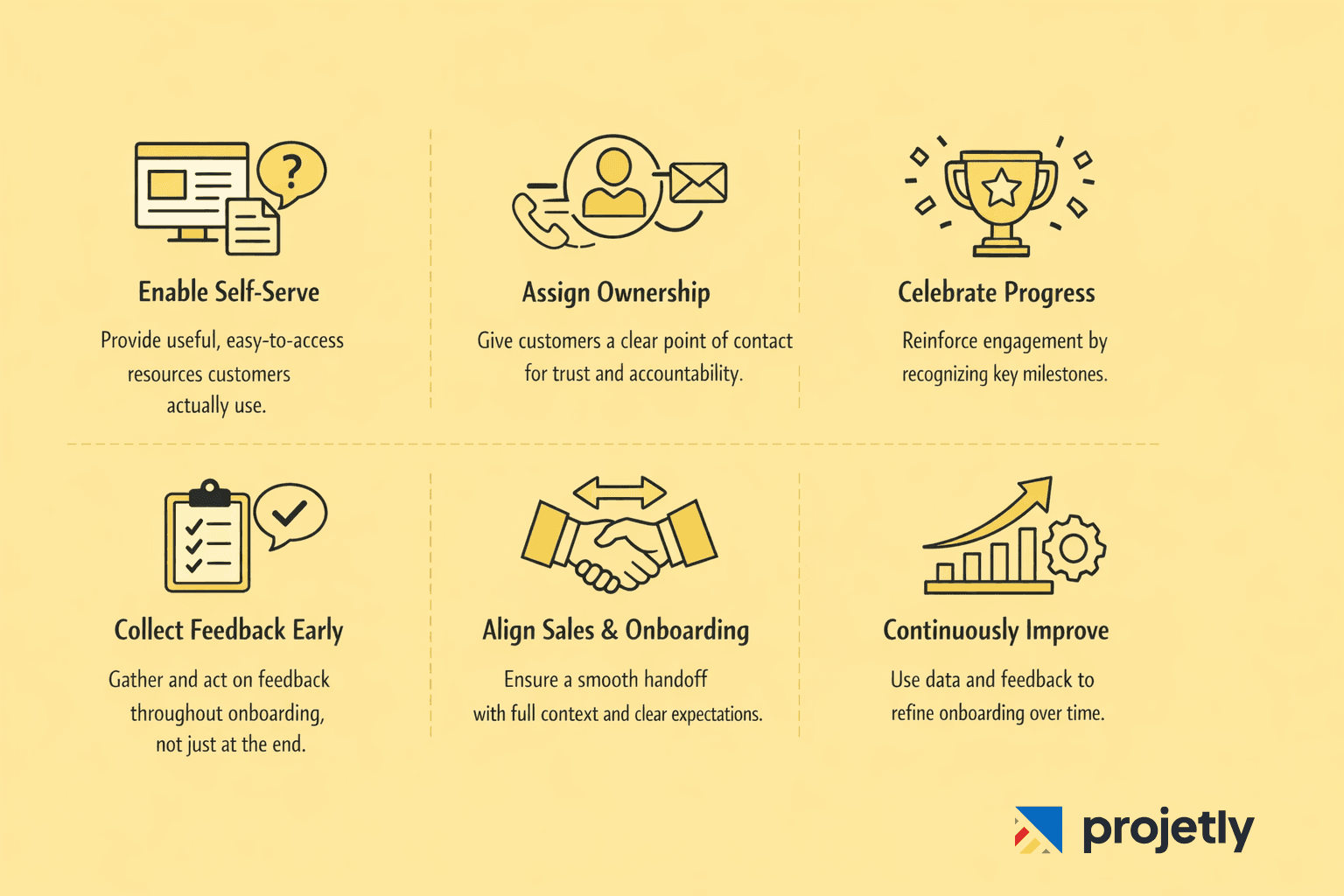
7. Create Self-Serve Resources That Actually Get Used
A knowledge base nobody uses is worse than no knowledge base at all; it creates a false sense of security. The best onboarding teams build self-serve resources that customers actively want to engage with.
This means video walkthroughs (not just text), interactive product tours, role-specific quick-start guides, and a searchable FAQ that answers real questions. The test: would a customer find the answer they need without contacting support? If not, the resource needs work.
8. Assign a Named Onboarding Point of Contact
Customers should always know exactly who to contact during onboarding, and that person should have a face, a name, and ideally a direct Slack channel or email address. Anonymized support queues erode trust during the most sensitive phase of the customer relationship.
Even in scaled, lower-touch onboarding programs, consider an "onboarding buddy" model where a customer is introduced to a specific person, even if that person handles 80 accounts, to create a sense of personal accountability.
9. Celebrate Milestones and Progress
Positive reinforcement is not just for gaming apps. When customers hit a meaningful milestone, completing setup, running their first report, or inviting their first teammate, acknowledge it. A congratulatory in-app message, an automated email, or a note from their specialist creates a positive emotional association with your product.
Milestone celebrations also serve a practical purpose: they create natural opportunities for your team to re-engage, gather feedback, and introduce the next phase of the onboarding journey.
10. Gather Feedback Continuously, and Act on It
Most onboarding teams survey customers once at the end of onboarding. That's too late. By then, any friction that caused frustration has already done its damage. Build feedback loops into every major onboarding stage.
Send a one-question pulse survey after the kickoff call: "How confident do you feel about getting started with [Product]?"
Run a short mid-onboarding check-in survey at the 30-day mark.
Conduct a formal NPS or CSAT survey at graduation.
Then close the loop. Share feedback themes with your product team. Update your onboarding content to address recurring confusion. Show customers that their feedback created a change; it builds trust and drives referrals.
Start your free trial and improve onboarding instantly
11. Align Onboarding with Sales Handoff
One of the most predictable sources of early churn is the gap between what Sales promised and what onboarding delivers. When expectations set during the sales process don't match the onboarding reality, customers feel misled, and they leave.
Fix this with a structured sales-to-onboarding handoff process. Before the first onboarding call, the onboarding specialist should receive: the customer's stated goals, key pain points, any custom commitments made during the sale, the decision-maker's priorities, and the timeline for seeing ROI. This information should live in the CRM and be reviewed before every kickoff.
12. Measure, Iterate, and Improve Relentlessly
B2B Onboarding is never finished. The programs that perform best in 2026 are those built on a culture of continuous improvement, regular retrospectives, data-driven iteration, and a willingness to tear up what isn't working.
Schedule a quarterly onboarding review that covers: what your data says (activation rates, TTFV, CSAT), what your customers are telling you, what your specialists are observing, and what's changed in your product or market. Then prioritize the top two or three improvements and execute them before the next review.
Let’s fix your onboarding, contact us
How to Measure Onboarding Success: The Metrics That Matter
If you can't measure it, you can't improve it. These are the KPIs every onboarding team should track, and what to do when the numbers aren't where you want them.
Metric | What It Measures | What to Do If It's Low |
Time-to-First-Value (TTFV) | Days from signup to first meaningful outcome | Remove setup friction; simplify the path to first action |
Activation Rate | % of customers who complete core onboarding milestones | Audit drop-off points; add proactive outreach at friction stages |
Onboarding Completion Rate | % who complete the full onboarding program | Improve communication cadence; clarify the program structure and timeline |
30/60/90-Day Retention | % of customers still active after each period | Identify common early-churn patterns; strengthen the post-onboarding handoff |
CSAT / Onboarding NPS | Customer satisfaction with the onboarding experience | Survey mid-onboarding; find specific friction points and fix them |
Feature Adoption Rate | % of customers using target features post-onboarding | Create targeted in-app nudges; add feature training to the onboarding flow |
Support Ticket Volume (Early) | Volume of support requests in first 90 days | Identify recurring questions; add proactive content and in-app guidance to address them |
Time-to-Productivity | Time for the customer to reach baseline competency/usage targets | Simplify onboarding curriculum; add role-specific training paths |
See which onboarding metrics actually drive retention, book a personalized demo.
Tools and Technology for a Modern Customer Onboarding Team
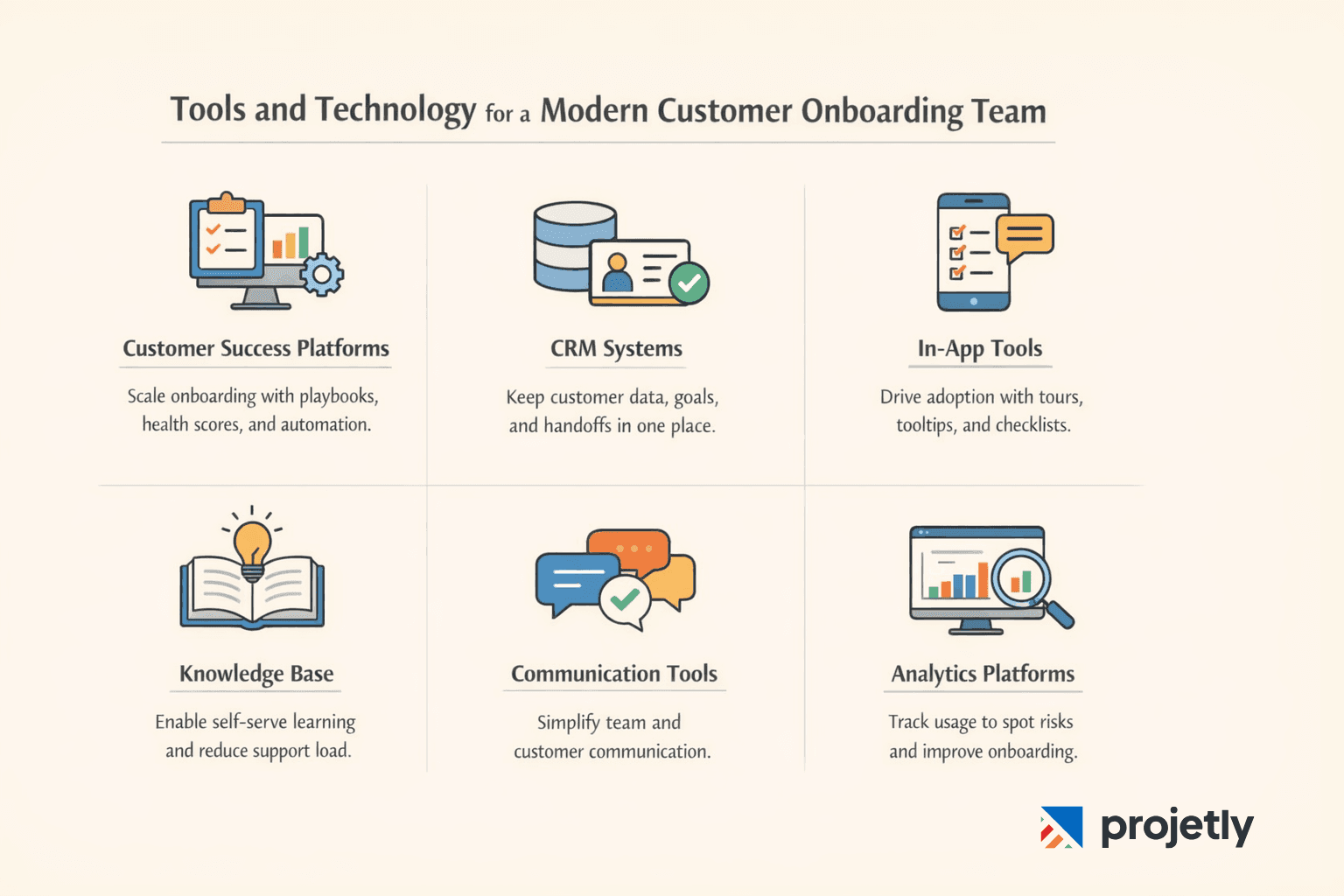
The right tool stack won't fix a broken onboarding process, but it will amplify a good one. Here are the categories of tools your team should have, and what to look for in each.
Customer Success and Onboarding Platforms
These are purpose-built for managing onboarding at scale, tracking customer health scores, automating touchpoints, and giving your team visibility into where every account stands. Look for tools that offer customizable onboarding playbooks, usage data integration, and automated alerts when customer behavior signals risk.
Leading options in 2026 include Gainsight, Totango, ChurnZero, and Catalyst. For PLG companies, tools like Pendo and Appcues offer in-app onboarding experiences and behavioral analytics.
CRM Systems
Your CRM is the system of record for every customer relationship. During onboarding, it should capture every interaction, note every commitment made during sales, and store the outcome goals that define success for this customer. Without strong CRM hygiene, onboarding continuity breaks down, especially at the handoff to Customer Success.
In-App Onboarding and Product Adoption Tools
Tools like Appcues, WalkMe, and Pendo let you build interactive product tours, contextual tooltips, progress checklists, and onboarding widgets directly inside your product, without engineering resources. These are especially valuable for PLG and scaled onboarding programs where human bandwidth is limited.
Knowledge Base and Self-Serve Learning
A well-structured knowledge base reduces support load and accelerates customer independence. Look for tools that offer video hosting, search functionality, and analytics on which articles are most viewed (and which are dead ends). Platforms like Zendesk, Intercom, Notion, and Guru work well for different scales and team sizes.
5. Communication and Collaboration Tools
Your onboarding team needs reliable tools for internal coordination and external customer communication. Slack or Microsoft Teams for internal collaboration, a shared inbox tool like Front or Help Scout for customer-facing communication, and a scheduling tool like Calendly to reduce the friction of booking calls are table stakes for any onboarding team in 2026.
Onboarding Analytics and Data Platforms
Usage data is the most honest signal of onboarding health. Tools that integrate your product database with your CRM, like Mixpanel, Amplitude, or Segment, let your onboarding team see exactly what customers are doing (and not doing) inside the product, enabling proactive outreach before problems become churn.
Try it free and deliver a better onboarding experience.
Building Your Customer Onboarding Strategy: A Step-by-Step Framework
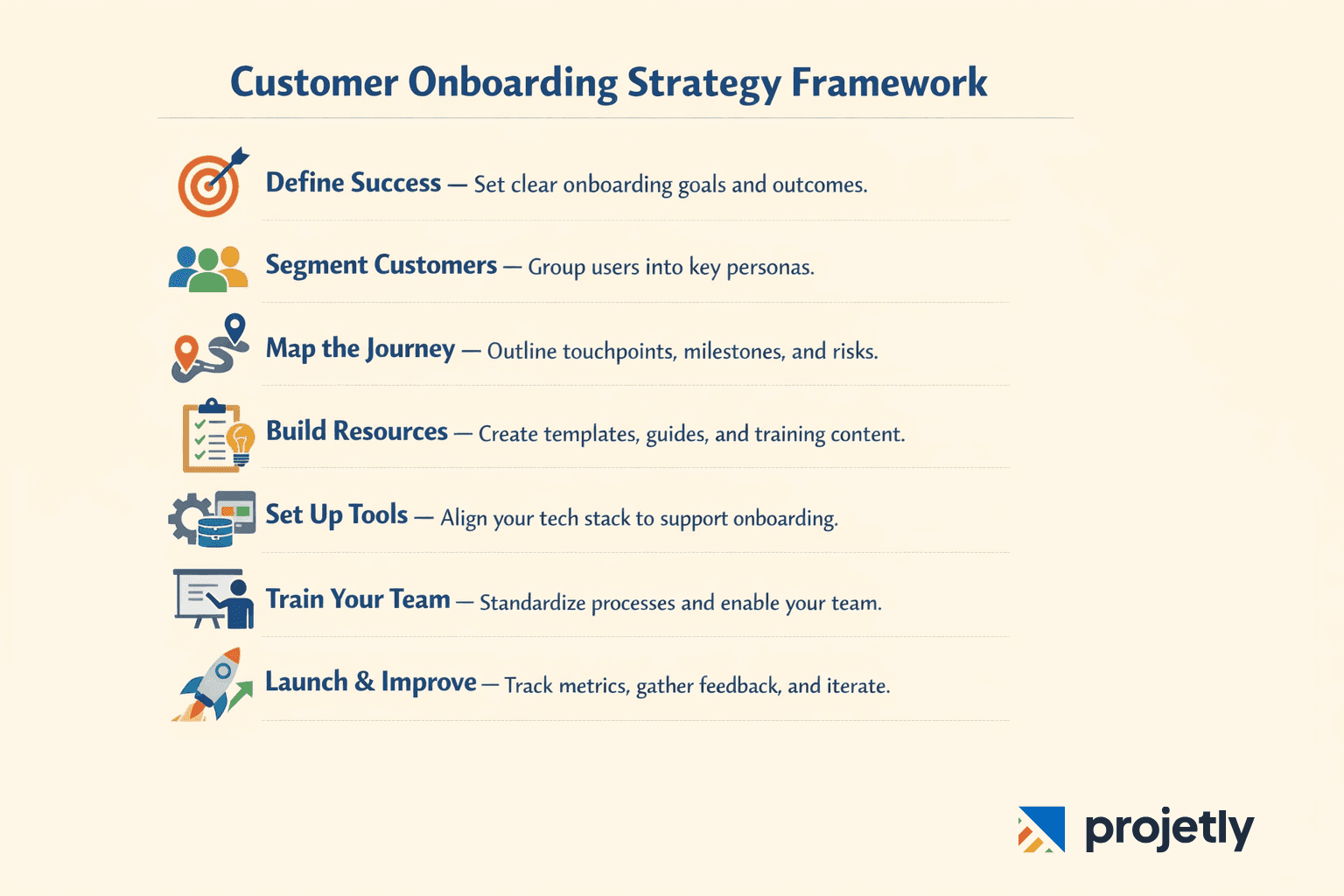
Strategy without execution is fantasy. Here is a practical framework for building or rebuilding your onboarding program from the ground up.
1. Step 1: Define your onboarding goals and success criteria. What does a successfully onboarded customer look like? What actions have they taken? What outcomes have they achieved? Write this down before you design anything else.
2. Step 2: Segment your customers into 3-5 personas. Use deal data, industry, company size, and primary use case to create distinct customer segments. Each segment will get a tailored onboarding track.
3. Step 3: Map the ideal onboarding journey for each persona. For each segment, document every touchpoint, milestone, and success criteria from kickoff to graduation. Identify the moments of greatest risk and greatest opportunity.
4. Step 4: Build your content and resources library. Create the materials your team needs to execute the journey: kickoff templates, training decks, video walkthroughs, checklists, and self-serve guides.
5. Step 5: Set up your technology stack. Configure your CRM, onboarding platform, in-app tools, and communication automations to support the journey you've designed.
6. Step 6: Train your onboarding team. Run internal workshops, build a playbook, shadow experienced specialists, and establish a regular cadence of knowledge-sharing and coaching.
7. Step 7: Launch, measure, and iterate. Go live with your new onboarding program, track your KPIs weekly, gather customer feedback continuously, and run quarterly retrospectives to improve.
Have questions about measuring onboarding success? Schedule a personalized demo.
5 Customer Onboarding Mistakes That Kill Retention
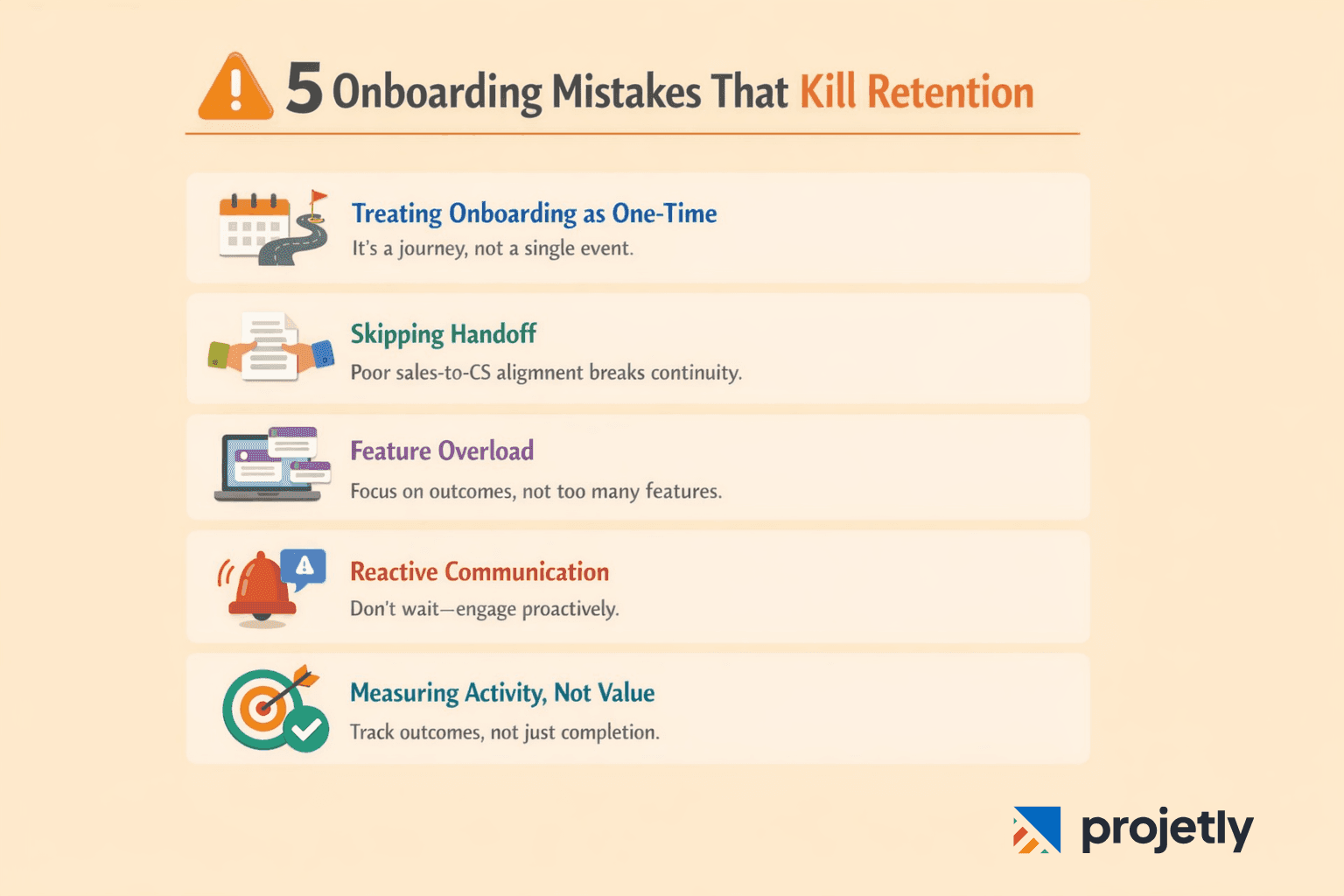
Even well-intentioned teams make these errors. Knowing them in advance is the first step to avoiding them.
Mistake 1: Treating Onboarding as a One-Time Event
Customer Onboarding is not a single kickoff call or a two-week sprint. It is an extended journey that, for complex products, can span 60 to 90 days or more. Teams that close out onboarding too early leave customers stranded at the exact moment when they're most likely to churn.
Mistake 2: Skipping the Sales-to-Onboarding Handoff
If your onboarding specialist doesn't know what was promised during the sales process, they are going into the kickoff call blind. This leads to misaligned expectations, repeated questions, and a customer who feels like they're starting from scratch with a new team.
Mistake 3: Feature-Dumping Instead of Value-Leading
Showing customers 40 features in the first two weeks is not onboarding; it is training overload. The best onboarding programs lead with outcomes, not features. Ask: What does this customer need to achieve first? Then guide them there.
Mistake 4: Reactive Instead of Proactive Communication
Waiting for customers to raise problems means you're always one step behind. By the time someone emails with frustration, the emotional decision to leave may already have been made. Monitor product usage data and communicate proactively when you see early warning signs.
Mistake 5: Measuring Completion Instead of Outcomes
Completing B2B onboarding steps is not a success. A customer who has sat through three training calls and set up their account but hasn't achieved any real-world value is still at churn risk. Track what customers have accomplished, not just what they've been through.
Start your free trial to onboard customers faster
Frequently Asked Questions
What is the difference between customer onboarding and customer training?
Customer onboarding is the broader process of guiding a new customer to success with your product. It includes relationship-building, goal-setting, and milestone tracking, not just instruction. Customer training is one component of onboarding, focused on building product knowledge and skills. Good onboarding always includes training, but effective training alone does not constitute onboarding.
How long should customer onboarding take?
The right onboarding duration depends on your product complexity and customer segment. A simple SMB SaaS product might have an effective 14-day onboarding program. A complex enterprise platform might require 60 to 90 days. The right length is defined by how long it takes a customer to reach their first major value milestone and achieve baseline competency, not by an arbitrary timeline.
What is time-to-first-value (TTFV) and why does it matter?
Time-to-first-value is the time between a customer's account creation (or deal close) and their first meaningful outcome with your product. It is one of the strongest predictors of long-term customer retention. The faster a customer experiences real value, the more committed they become to continuing with your product. Every onboarding team should know their average TTFV and have a plan for reducing it.
How do you measure the ROI of customer onboarding?
Measure onboarding ROI by tracking the difference in retention rates, expansion revenue, and support costs between well-onboarded and poorly-onboarded customers. Strong onboarding teams typically see 20-40% higher 90-day retention rates for customers who complete the onboarding program versus those who don't. They also see a meaningful reduction in support ticket volume and faster time to first upsell or expansion.
What is the difference between high-touch and low-touch customer onboarding?
High-touch onboarding involves significant human involvement, dedicated specialists, regular live calls, custom training, and hands-on support. It is typically used for enterprise or high-value accounts. Low-touch or digital onboarding relies primarily on self-serve resources, automated email sequences, in-app guidance, and product-led experiences. It is designed to scale across large volumes of SMB or self-serve customers. Most successful onboarding programs blend both approaches, reserving human time for the highest-risk or highest-value moments.
6. How do you handle customers who are unresponsive during onboarding?
Unresponsive customers are a signal, not a dead end. First, try different channels. If email isn't working, try a phone call, a LinkedIn message, or a message through your product's in-app notification system. Second, involve a senior contact or executive sponsor if you're dealing with an enterprise account. Third, send a clear, low-pressure re-engagement message that makes it easy for them to resume. If a customer remains unresponsive after 30 days with no product usage, treat them as an active churn risk and escalate internally.
Onboarding Is Not a Department, It's a Growth Strategy
The most successful companies in 2026 do not treat customer onboarding as an administrative necessity that happens after the sale. They treat it as a core growth lever, the mechanism that turns acquisition investment into retention, expansion, and advocacy.
The principles in this guide, journey mapping, time-to-value obsession, proactive communication, persona-based personalization, and continuous measurement, are not new ideas. But the teams that execute them with discipline and rigour are the ones that build the compounding retention advantages that define category leaders.
Start with your biggest onboarding friction point. Fix that first. Then keep going.
Want to improve your onboarding team's performance? Start by auditing your current time-to-first-value metric. If you don't know it, that's your priority. If you do, your challenge is to cut it by 20% in the next quarter. |
You may also like

A Guide to Project Management Professional Certification

Laugh Your Way to Productivity: 50 Workplace Quotes

50 Funny Workplace Memes That’ll Brighten Your Workday.
What Does a Customer-First Mindset Mean? Explained in 2025

What It Takes to be a Great Customer Success Manager in 2025